
EHT Set to Unveil the First-Ever Image of a Black Hole
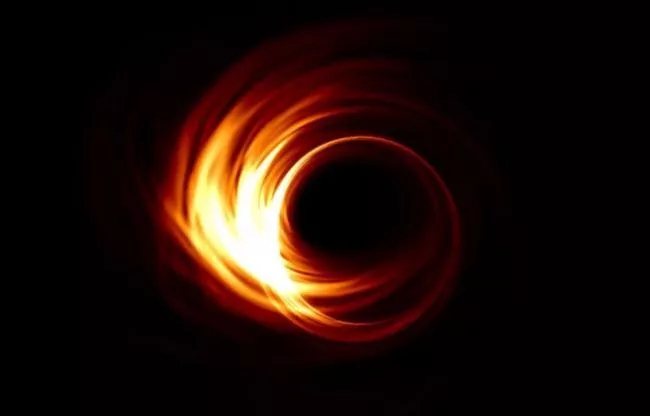
Image: © EHT Outreach/YouTube
The EHT recently announced a press conference for April 10, 2019. Its statement read in part:
On April 10, 2019, the Event Horizon Telescope (EHT) collaboration will hold simultaneous press conferences in several regions around the world to present its latest research results, together with numerous events organized by researchers and affiliated institutions. The press conferences will take place simultaneously in Brussels (English), Lyngby (Danish), Santiago (Spanish), Shanghai (Chinese), Tokyo (Japanese), Taipei (Chinese), and Washington (English), beginning at 13:00 UTC (21:00 Beijing time).
The Shanghai Astronomical Observatory of the Chinese Academy of Sciences and Taiwan’s Academia Sinica Institute of Astronomy and Astrophysics also announced local press conferences.

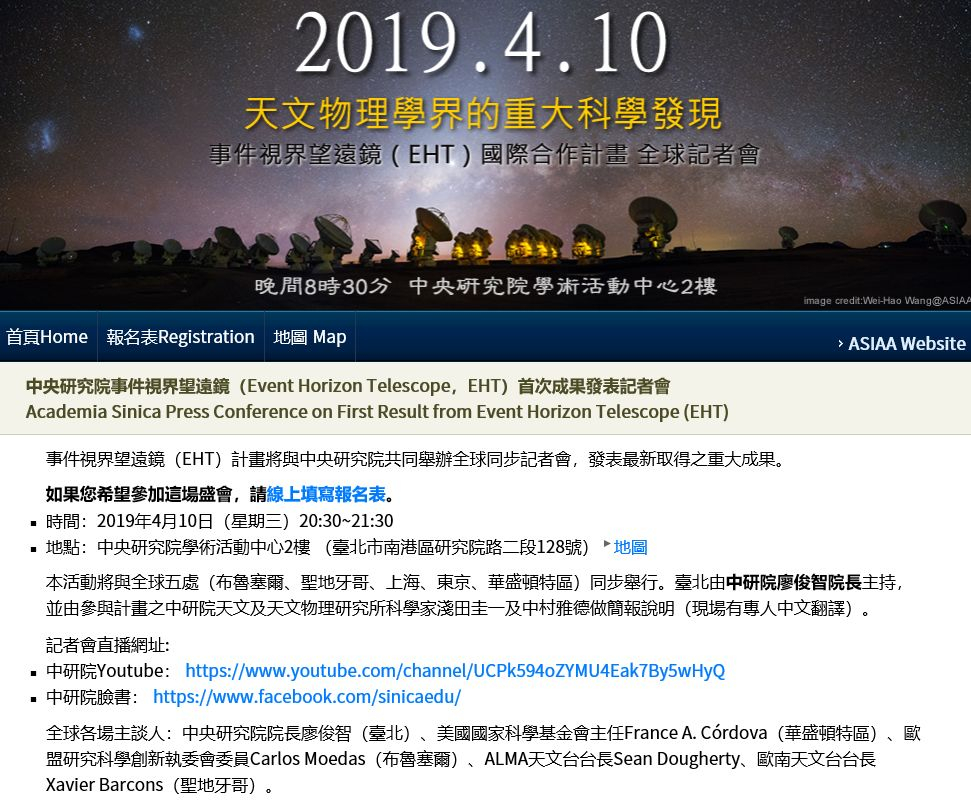
The press conferences across six countries and regions will begin at 9:00 p.m. Beijing time on April 10. Astronomers are excited because a black hole’s gravity is so strong that not even light can escape. Its pull sends nearby objects into rapid orbits, and observations of those objects have made the case for black holes widely accepted. Yet no one has ever truly “seen” one. The star S0-2 completes an orbit in 15.2 years and reaches nearly 3% of the speed of light, or 9,000 kilometers per second. For comparison, the Solar System takes about 230 million years to orbit the center of the Milky Way at only about 250 kilometers per second.
Despite its name, the Event Horizon Telescope is not one enormous instrument. It is a network of eight radio telescopes in Hawaii, Arizona, Spain, Mexico, Chile, and Antarctica. In April 2017, the network observed two giants: Sagittarius A*, the supermassive black hole at the center of the Milky Way, and an even larger black hole in the galaxy M87, 53.5 million light-years away. After nearly two years of processing the data, the team is preparing to release its first black-hole images this April.
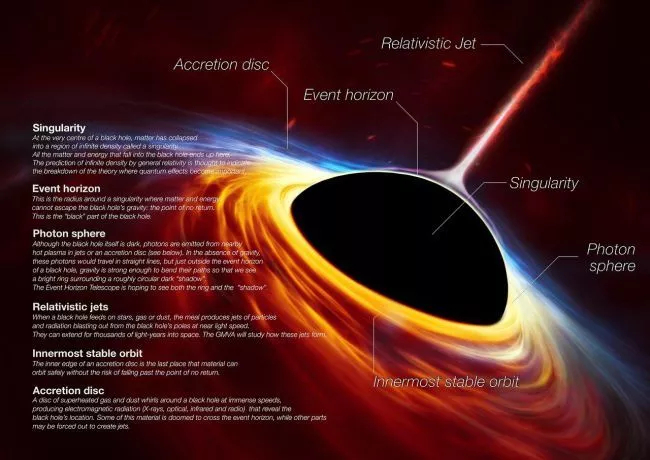
Image: © ESO, ESA/Hubble, M. Kornmesser/N. Bartmann
Black holes are extraordinarily hard to observe. “Finding a black hole is about as difficult as trying to find and observe an orange placed on the Moon from Earth,” said Sheperd Doeleman, director of the Event Horizon Telescope project. A black hole may dwarf a planet or a person, but against the Milky Way it is minuscule, making its event horizon extremely difficult to image. “The EHT’s target is roughly 10% the size of our Solar System,” University of Amsterdam astrophysicist Sera Markoff said during a panel discussion. Doeleman added, “Sagittarius A*, the supermassive black hole at the center of the Milky Way, is only about the size of Mercury’s orbit.” The Milky Way is around 50 billion times larger than Sagittarius A*. Even from a vantage point outside the galaxy, picking out the black hole among its billions of stars and planets would be daunting.
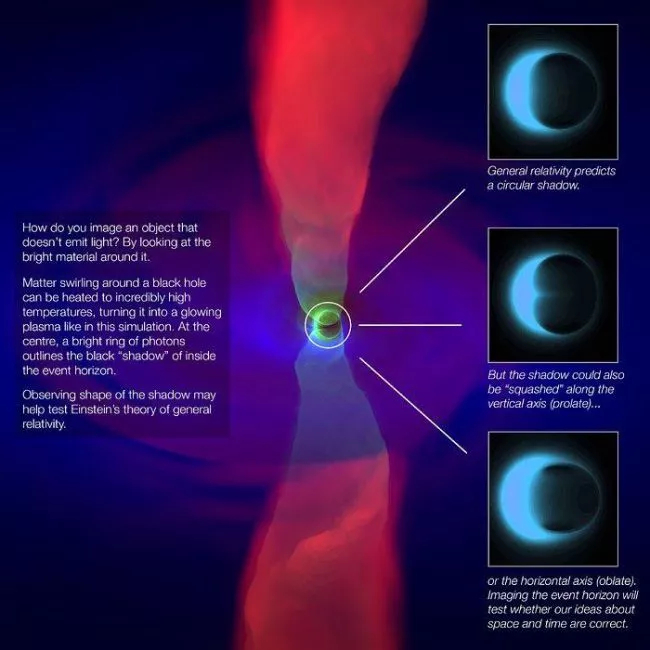
Image: © ESO/N. Bartmann/A. Broderick/C.K. Chan/D. Psaltis/F. Ozel
“At the heart of the project, 200 scientists want to answer two questions,” said University of Arizona astronomer and physicist Psaltis. “The first is simple: is it possible to photograph a black hole? Their second question is the important one. Scientists want to know whether Einstein’s theory of black holes is completely correct. A hundred years ago, Einstein told us what the size and shape of a black hole’s horizon should be. If we can place a measuring ‘ruler’ across the horizon, we can test Einstein’s theory of black holes.”
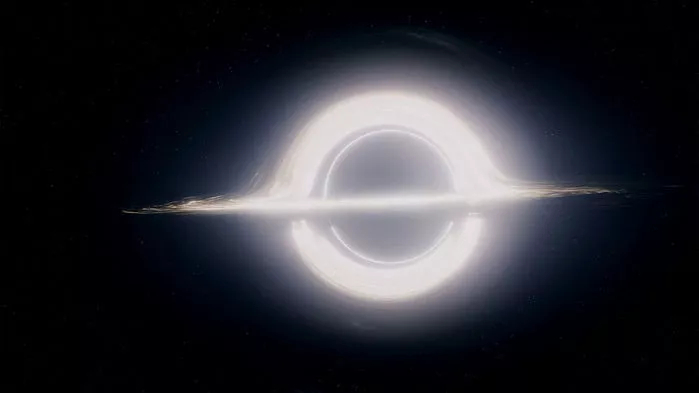
Image:AF ARCHIVE/ALAMY STOCK PHOTO
Fiction tends to portray black holes more imaginatively. Gargantua, for example, serves as a time-travel plot device in Interstellar. No one yet knows whether the image reconstructed from EHT data will resemble the film’s elaborate CGI. Beyond making an accurate image of the horizon, scientists hope the observations will reveal more about the physics of black holes.
“Because LIGO—the Laser Interferometer Gravitational-Wave Observatory—has found that the spacetime around black holes closely matches Einstein’s predictions from relativity, I hope the EHT data will pin down the physical details of how gas accretes onto and is ejected from around supermassive black holes,” said Abraham Loeb, professor and chair of astronomy at the Harvard-Smithsonian Center for Astrophysics. “A century after the theory of black holes was formulated mathematically, people are about to see the face of a black hole for the first time. Karl Schwarzschild and Albert Einstein would surely be thrilled if they could see this image.”
Appendix: Livestreams for anyone eager to watch (a VPN may be required):
Shanghai (Chinese): (The Shanghai link does not require a VPN. Follow the “Read the original” link at the end of the article to enter the stream.) http://www.xinhuanet.com/politics/ksh/zhibo/201904/3731328_m.html?type=mobile
Taipei (Chinese): https://m.youtube.com/watch?v=_GsTBTenBZY&feature=youtu.be
Washington (English): https://m.youtube.com/c/VideosatNSF/live
Brussels (English): https://m.youtube.com/watch?v=Dr20f19czeE&reload=9
Tokyo (Japanese): https://m.youtube.com/watch?v=_QBQMT5vrJo
References
Space.com:https://www.space.com/event-horizon-telescope-is-trying-to-photograph-black-holes.html
Science:https://www.sciencemag.org/news/2019/04/here-s-what-scientists-think-black-hole-looks
SaLon.com:https://www.salon.com/2019/02/03/scientists-are-on-the-verge-of-imaging-a-black-holes-shadow-for-the-first-time/
Official websites: Shanghai Astronomical Observatory, Chinese Academy of Sciences; Academia Sinica Institute of Astronomy and Astrophysics
 爱发电(点击图片跳转)