
What Makes an Argument Valid?
Author: Taosheng
A friendly warning: you may need to read this article carefully, one section at a time, and go through it more than once. Brace yourself.
Section 1: Introduction;
Section 2: Propositions;
Section 3: The Four Types of Categorical Propositions;
Section 4: Syllogisms;
Section 5: Conclusion.
Feel free to jump to whichever section best matches your level.
Section 1: Introduction
As we happily surf the internet, we run into all kinds of views: some incisive, some warm and resolute, and some elaborate comic bits. We tend to accept certain views and reject others. Doing so can deepen our understanding of an issue and help us form views of our own, while also giving us emotional support.
From this perspective, a view has value simply by existing, no matter how unreasonable or unacceptable it may be factually, intellectually, or emotionally. But does that mean we can propose and use any view we please?
Imagine a group whose members can express their opinions freely, agree or disagree with one another, and decide major issues by majority rule. What kind of future awaits this group?
Without objective standards for judging views, communication becomes little more than bonding over “What a coincidence—you think so too.” We cannot guarantee that every widely accepted view benefits the group, so its future becomes extremely uncertain. Is there any way to arrive at a correct view, or at least one that is correct from a particular perspective?
Fortunately, there is always a way! It just takes some brains. We need to introduce a pair of concepts: “true” and “false.” Once we have them, we at least possess an objective tool for judging the views we use.
We generally consider a view false when it conflicts with objective fact. Many views, however, cannot be reached simply by observing facts: “It will rain on this date next year.” (We cannot know because of the limits of time.) The air in the United States is sweet. (We cannot know because of the limits of space.) God exists. (The concept itself is difficult to determine.) We need to make extensive use of inference to construct arguments.
For example, air is almost never sweet, so the air in the United States is almost certainly not sweet. (In Boston’s North End in 1919, though, the air really was sweet.) We need an art of reasoning that helps us make judgments like this.
Let us learn the art of inference! Remember the intelligence mentioned above? Now it is time to use it. Do not worry; after all, I do not have any either.
Section 2: Propositions
First, let us consider a proposition. Every proposition asserts that something is a certain way.
China is a populous country.
The apple is no longer crisp.
It is raining.
All of these are propositions. We can affirm or deny a proposition, but every proposition asserts that something is or is not a certain way. Such an assertion must either agree or conflict with objective fact. Every proposition is therefore either true or false; none is both.
The truth of some propositions is difficult to establish. Given our present knowledge, for example, we do not know whether the proposition “extraterrestrials exist” is true or false. Like every other proposition, however, it must be one or the other and cannot be both.
Questions, commands, and exclamations are clearly sentences, but they cannot be propositions. “Does your head hurt now that you have read this far?”, “Hurry up!”, and “Oh my goodness!” assert nothing and are neither true nor false.
Section 3: The Four Types of Categorical Propositions
Next, let us look at the four types of categorical proposition.
A categorical proposition, also called an attributive proposition, asserts that an object does or does not possess a certain property. Each proposition below is categorical.
① The APC Alliance is an excellent science-outreach organization.
② No dogs are humans.
③ Some apples are made into Bad Apple!!
④ Some students do not like studying formal logic.
A categorical proposition is expressed in subject-predicate form and consists of four parts: the quantifier, subject term, copula, and predicate term.
The subject term identifies the object about which an assertion is made. In the examples above, “the APC Alliance,” “dogs,” “apples,” and “students” are subject terms. They usually resemble the grammatical subject of a sentence.
The predicate term describes a property of the object. In the examples above, “excellent science-outreach organization,” “humans,” “made into Bad Apple!!,” and “studying formal logic” are predicate terms. They usually resemble grammatical predicates.
The copula connects the subject and predicate terms. In the examples above, it marks the difference between “possesses” and “does not possess” and determines whether a proposition is affirmative or negative. An affirmative copula is usually expressed by the judgment word “is,” while a negative copula is usually expressed by “is not.” As noted earlier, a proposition either affirms that something possesses a property or denies that it does. Every proposition therefore has a copula, and that copula must be either affirmative or negative, never both. Propositions ① and ③ contain the affirmative copula “is,” while ② and ④ contain the negative copula “is not.”
The quantifier states how much of the subject term is being asserted. A quantifier that covers the subject term’s entire range is a universal quantifier, usually expressed by words such as “all,” “every,” or “any.” A universal quantifier can be omitted; proposition ②, for example, can also be expressed as “Dogs are not humans.” A quantifier that covers only part of the subject term’s range is a particular, or existential, quantifier, usually expressed by “some,” “part of,” or “some among them.” A particular quantifier cannot be omitted. The word “some” in propositions ③ and ④ absolutely cannot be removed without changing their meaning. A proposition with a universal quantifier is called a universal proposition, while one with a particular quantifier is called a particular proposition. One point must be especially clear: the exact meaning of the particular quantifier “some” is “at least one exists,” not “there are some and only some.” In proposition ④, for example, there is no upper limit on the number of students who dislike studying logic—or rather, that number may be as high as all of them. Even if every student dislikes studying formal logic, we can still say that “some students do not like studying formal logic.” Proposition ④ does not, however, assert that any students do like studying formal logic.
Once we understand the quantifier, subject term, copula, and predicate term, we can easily see that the subject and predicate positions can be filled with all kinds of content, whereas the quantifier can contain only “all” or “some” and the copula only “is” or “is not.” We therefore call the subject and predicate terms the variables of a categorical proposition, and the quantifier and copula its constants.
To spare a few brain cells and make categorical propositions easier to study, we will use a simpler method: symbolization.
The contents of the two variables—the subject and predicate terms—vary endlessly, while pairing the two constants—the quantifier and copula—produces only 2×2=4 possibilities. Why not make those combinations the focus of our description of a categorical proposition?
We can also observe that every categorical proposition has this form:
(quantifier) + subject term + (copula) + predicate term
None of these four parts can be absent from a categorical proposition. The parentheses merely indicate that, in some of the situations described above, the part can be omitted in everyday language. Restoring the omitted terms in the ordinary sentence “People grow up,” for example, gives “All people are beings that grow up.”
In summary, we use S and P for the subject and predicate terms, and A, E, I, and O for the different combinations of quantifier and copula. They can be represented as follows:
SAP—a universal affirmative proposition (All … are …)
SEP—a universal negative proposition (No … are …)
SIP—a particular affirmative proposition (Some … are …)
SOP—a particular negative proposition (Some … are not …)
Propositions ①, ②, ③, and ④ above have the forms SAP, SEP, SIP, and SOP, respectively. Be sure to remember them.
A E I O
A E I O
A E I O
A E I O
(Important things must be said three times, so we deleted the fourth line.)
All right, does everyone remember? Let us begin the cheerful adventure below!
Section 4: Syllogisms
At long last: welcome to the world of the syllogism!
You have surely seen inferences of the following form:
Ⅰ.
No cats like eating century eggs,
Some people like eating century eggs,
——————————
Therefore, some people are not cats.
Let us examine this inference together.
In this set of categorical propositions, two propositions appear above the dividing line and one appears below it. The two propositions above are used to infer the two propositions below. Three terms—cats, people, and century eggs—appear in the set, each exactly twice.
We call an inference of this form a categorical syllogism. It normally consists of three categorical propositions: two categorical propositions serving as premises, and one serving as the conclusion. Exactly three terms occur in them, and each term appears exactly twice in the propositions that make up the syllogism.
For a more precise analysis, such an inference must be put into standard form. (Consider this a brain-friendly convention.) A standard-form categorical syllogism must satisfy two conditions:
a. Its premises and conclusion must all be standard categorical propositions (A, E, I, or O).
b. These propositions must appear in a special order. (Premises—conclusion; more detail follows below.)
Just as we identified four parts of a categorical proposition—the subject term, predicate term, quantifier, and copula—we can name the three terms in a categorical syllogism. Syllogism Ⅰ, for example, contains three terms: people, cats, and century eggs.
To identify the three by name, we generally begin with the conclusion. The conclusion of syllogism Ⅰ is an O proposition (SOP): “Some people are not cats.” The conclusion’s subject term, “people,” is called the minor term; its predicate term, “cats,” is called the major term. The term that does not appear in the conclusion but occurs twice in the premises, “century eggs,” is the third term and is called the middle term.
The premises of a categorical syllogism also have names derived from the terms they contain. The major and minor terms must appear in different propositions. The premise containing the major term is called the major premise. In syllogism Ⅰ, “cats” is the major term, so the premise containing it—“No cats like eating century eggs”—is the major premise.
The premise containing the minor term is called the minor premise. In syllogism Ⅰ, “people” is the minor term, so the premise containing it—“Some people like eating century eggs”—is the minor premise.
Note that the propositions are called the major and minor premises because of whether they contain the major or minor term, not because of the order in which they appear. No matter how the two premises are arranged, the one containing the major term is the major premise, and the one containing the minor term is the minor premise.
When the premises of a syllogism are arranged in standard order, the result is called the standard form of a categorical syllogism. Remember “condition b for the standard form of a categorical syllogism” above? (I hope you are not dizzy yet, because what follows is even more dizzying.) We can now describe that order formally:
Major premise
Minor premise
————
Conclusion
In a standard-form categorical syllogism, the major premise comes first, the minor premise second, and the conclusion last. Yes, you read that correctly. It is that simple! Remember it well.
Next, we will discuss the mood and figure of a categorical syllogism. (Give your brain a moment to rest before we begin, mortal!)
Every categorical syllogism has a mood, determined by the standard categorical propositions it contains, identified as A, E, I, or O. The mood consists of three letters in a specified order. The first indicates the type of the major premise, the second the type of the minor premise, and the third the type of the conclusion. In syllogism Ⅰ, the major premise, “No cats like eating century eggs,” is an E proposition in SEP form; the minor premise, “Some people like eating century eggs,” is an I proposition in SIP form; and the conclusion, “Some people are not cats,” is an O proposition in SOP form. Its mood is therefore EIO. We can enumerate 4×4×4=64 different moods of categorical syllogism.
Mood alone does not fully characterize the form of a standard categorical syllogism. A comparison of two syllogisms with the same mood shows that they can differ radically in their logic.
Ⅱ.
All flying insects are winged things.
Some birds are winged things.
——————————
Therefore, some birds are flying insects.
Ⅲ.
All enthusiastic eaters are happy people.
Some enthusiastic eaters are students.
——————————
Therefore, some students are happy people.
Both have the AII mood, but categorical syllogism Ⅱ is invalid, while syllogism Ⅲ is valid. Their “skeletons” make this difference in form perfectly clear. Let S stand for the minor term, P for the major term, M for the middle term, and “∴” for “therefore.” We then obtain these two skeletons:
Ⅱ.
PAM
SIM
————
∴SIP
Ⅲ.
MAP
MIS
————
∴SIP
They are very different. In categorical syllogism Ⅱ, the middle term is the predicate of both premises. In syllogism Ⅲ, it is the subject of both. Syllogism Ⅲ is regarded as valid, while Ⅱ is invalid.
These two examples show that although mood partly describes the form of a categorical syllogism—both examples have the AII mood—syllogisms with the same mood can still differ in other important formal respects. We must also consider the relative position of the middle term. A complete description of a categorical syllogism’s form therefore requires both its mood, the three letters representing its propositions, and its figure, the position of the middle term in the premises.
There are exactly four figures of categorical syllogism:
The middle term is the subject of the major premise and the predicate of the minor premise;
The middle term is the predicate of both premises;
The middle term is the subject of both premises;
The middle term is the predicate of the major premise and the subject of the minor premise.
These possible arrangements of the middle term form the first, second, third, and fourth figures, respectively. Every categorical syllogism belongs to exactly one of them. To make the figures easier to remember—check your brain’s temperature first so it does not burn out—we will present them more visually. The arrangements below show only the middle term’s relative position; their moods are hidden, as are their quantifiers and copulas.
M——P
S——M
——————
∴S——P
First figure
(Remember M as a right-falling stroke.)
P——M
S——M
——————
∴S——P
Second figure
(Remember M as a vertical line on the right.)
M——P
M——S
——————
∴S——P
Third figure
(Remember M as a vertical line on the left.)
P——M
M——S
——————
∴S——P
Fourth figure
(Remember M as a left-falling stroke.)
At this point, specifying the mood and figure of a standard categorical syllogism is enough to describe its form completely. Syllogism Ⅰ belongs to the second figure because its middle term, “century eggs,” is the predicate of both premises. As noted above, its mood is EIO. The full description of this standard categorical syllogism is therefore EIO-2. It is valid.
We calculated above that a categorical syllogism has 64 possible moods. Since it also has four possible figures, a standard-form categorical syllogism must have 64×4=256 possible forms.
As we have seen, however, most of them are invalid. Only 15 forms are valid in every case.
They are:
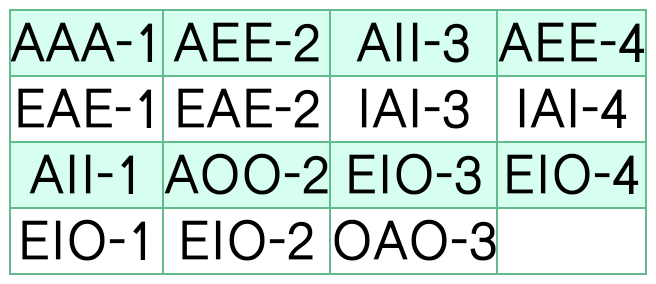
One point is especially important: a conclusion is necessarily true only when both categorical propositions serving as premises are true and the syllogism’s form is valid.
For example, the “Logic and Chinese-Language Study” unit in the old experimental edition of the People’s Education Press compulsory high school Chinese textbook, Book 4, treats the saying “No one is a sage; who can be free of fault?” as an elliptical categorical syllogism. It reconstructs the argument as follows:
Ⅳ.
Sages are people who never make mistakes,
We are not sages,
——————————
Therefore, we are not people who never make mistakes (we all make mistakes).
In fact, this syllogism has both a false major premise and an invalid form. “Sages are people who never make mistakes” conflicts with history and common sense: every sage throughout history has made mistakes. The syllogism has the form AOO-1, which is itself invalid.
Section 5: Conclusion
Our journey through traditional formal logic is complete! I hope that when you encounter views that agree or disagree with your own, you will use the basic methods this article has tried to explain to evaluate and think about them, rather than simply picking a side or starting an online fight.
And that is the art of inference: demonstrating that an argument is valid.
(All right, I am going to drink some ice-cold cola and cool down my brain QAQ.)
⭐ Notes:
This article fast-forwards to the valid forms of syllogism, omitting a great deal of traditional formal logic. Important omitted topics include concepts (terms), the square of opposition, obversion and conversion, definition by genus and specific difference, distribution, the basic rules of categorical syllogism, traditional and Boolean interpretations, and proofs of the 15 valid forms of standard categorical syllogism.
This article does not address fallacies in everyday language or informal logic; readers can explore these topics independently. Important fallacies include appeals to emotion, appeals to force, red herrings, straw men, and equivocation.
Some terminology in this article is imprecise. The concept of a term, for example, is not clearly defined. This is a compromise made for explanatory purposes; readers can investigate further on their own.
This article does not cover modern formal logic (mathematical logic) or dialectical logic. Readers can explore them independently.
Logic is a tool for thought. It cannot replace the important role of other disciplines and must not be used to undermine sound moral values or pursue interests other than truth. Please remember this!
 爱发电(点击图片跳转)