
The Phases of Earth as Seen from the Moon
The Phases of Earth as Seen from the Moon
Author: Congyu
Reviewed by: Yuandao and Shiguang
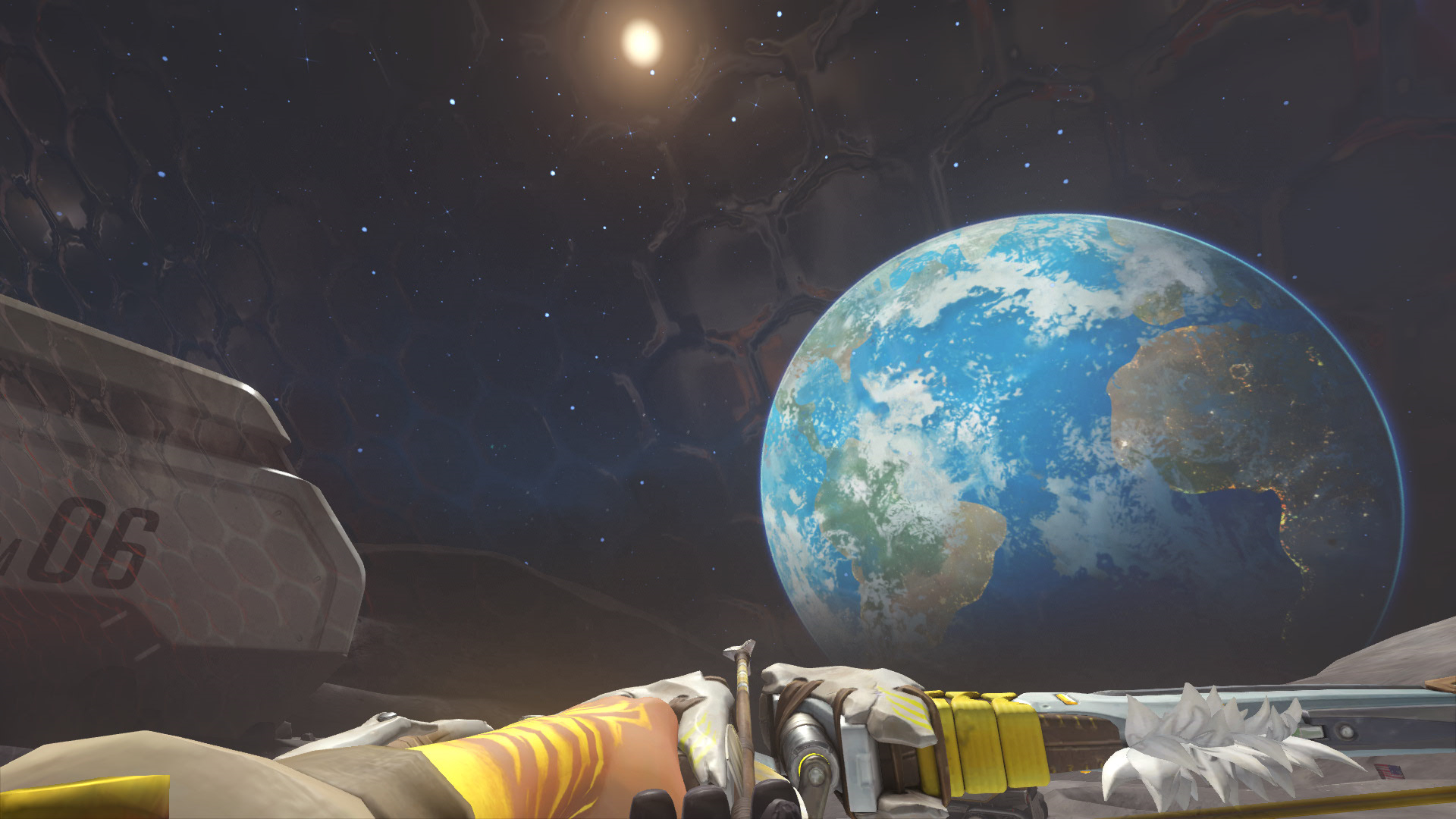
What does Earth look like from the Moon? If you know a little about the Earth–Moon system and lunar phases, you may already sense that something is wrong with this image. It comes from Horizon Lunar Colony, a map in the game Overwatch. Setting artistic license aside, the screenshot gives us a useful starting point for exploring the phases of celestial bodies.
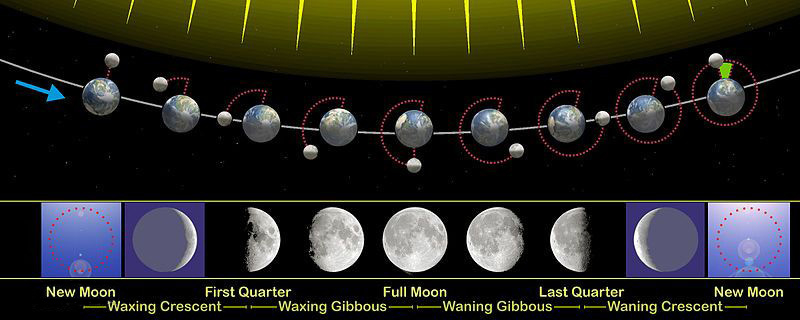
A celestial body's phase depends on the relative positions of the Sun, the body, and the observer. It tells us how much of the sunlit side is visible. Consider the familiar phases of the Moon. Because the Sun is much farther from Earth than the Moon is, the Sun–Earth–Moon angle, or the angular separation between the Sun and Moon, provides a simple measure of the illuminated portion we can see. As that separation changes, the Moon passes through new moon, waxing crescent, first quarter, waxing gibbous, full moon, waning gibbous, last quarter, waning crescent, and back to new moon. At quarter phase, the Moon is about 90 degrees from the Sun in the sky; at full moon, it is about 180 degrees away.
Each lunar phase has a fixed position relative to the Sun. From the Moon's direction in the sky, you can infer where the Sun is and estimate the local time. If we ignore the inclination of the Moon's orbit to the ecliptic, for example, a first-quarter moon rises and sets six hours after the Sun, while a last-quarter moon does so six hours earlier.
The same rules govern the “phases of Earth” seen from the Moon. In the opening screenshot (Figure 1), Earth's terminator makes it look like a waning gibbous Earth approaching last quarter. Yet Earth is clearly less than 90 degrees from the Sun at the upper left. Most of the illuminated hemisphere should therefore lie on the far side, out of view, leaving Earth as a waning crescent.
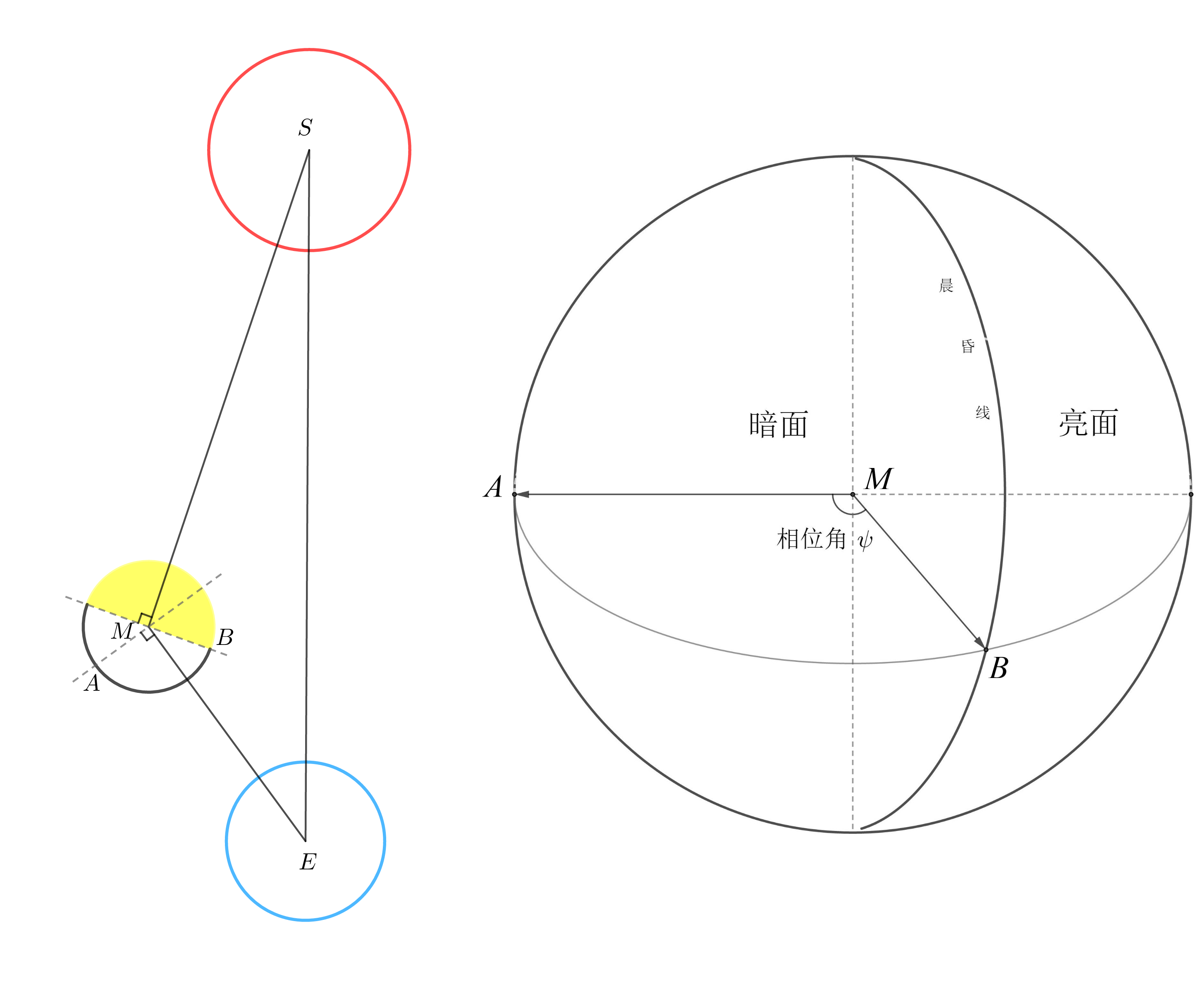
More precisely, a celestial body's phase is described by the Sun–Moon–Earth angle, called the phase angle. As Figure 3 shows, this angle ranges from 0° to 180°, while the illuminated portion spans an angle of 180°-ψ. From a distance, the terminator between the bright and dark sides appears as half of an ellipse divided along its major axis. The sharply hooked crescents sometimes drawn in animation and other visual media do not occur as normal celestial phases. Nor does the edge of Earth's shadow during a lunar eclipse have the same curvature as an ordinary lunar phase. Near the Moon's orbit, Earth's umbra has a radius 2.6 times that of the Moon, so its edge curves less sharply than the Moon's limb.
The Moon is not the only Solar System body with phases. The inner planets pass through the full range, although in the reverse order from the Moon: inferior conjunction corresponds to new phase, greatest western elongation to last quarter, superior conjunction to full phase, and greatest eastern elongation to first quarter. The corresponding phase angles are 180°, 90°, 0°, and 90°. Outer planets, because they orbit beyond Earth, never reach a phase angle greater than 90°. By analogy with an inner planet at greatest elongation, an outer planet reaches its maximum phase angle when Earth is at greatest elongation as seen from that planet. We can therefore never see an outer planet as a crescent from Earth. Even Mars, on the orbit closest to ours, always shows us at least 84% of its illuminated side.
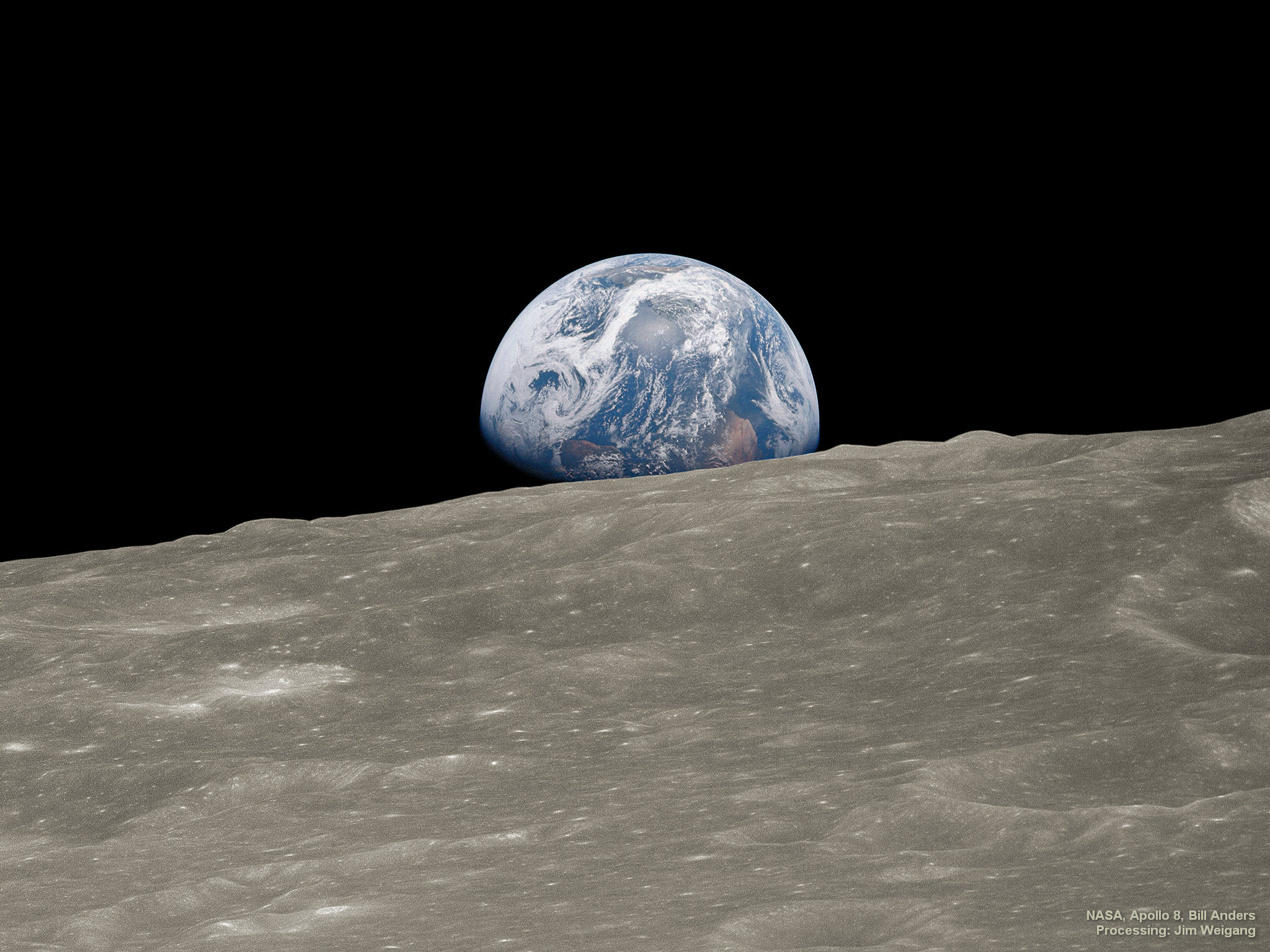
Finally, consider this haunting view of Earth, photographed from lunar orbit by Apollo 8 in 1968. The astronauts marveled as Earth seemed to “rise” above the Moon's horizon outside their window. From the lunar surface, however, an Earthrise or Earthset would be hard to see. The Moon is tidally locked to Earth, keeping the same hemisphere pointed toward us. For someone stationed on its surface, Earth would hang at nearly the same altitude and bearing in the sky, shifting only slightly with lunar libration.
All articles in this blog are licensed under CC BY-NC-SA 4.0 unless stating additionally.
 爱发电(点击图片跳转)