Why Do Mushrooms Form Rings in Grass?
After rain, mysterious rings of mushrooms can appear in grass—and even in the game Sky: Children of the Light. Some have been growing for decades or even centuries. How do these strange rings form? Why do some make the grass greener while others are classified as turf diseases? Let us uncover the secrets behind mushroom rings.
Authors: 阿氯、时光
Reviewed by: 星海中的蓝玫瑰
After the rain has cleared, have you ever seen clusters of mushrooms arranged in a circle on a lawn, as though someone had deliberately planted a ring of tiny umbrellas? In folklore, the phenomenon is often called a fairy ring or mushroom ring; in Chinese scientific usage, it is usually known as a xùn ring. What you may not know is that some large mushroom rings have been growing underground for more than a century.
What we call a “mushroom” is usually the fruiting body that a fungus uses to produce and disperse spores. The fungus’s true body is a mycelium hidden in the soil or leaf litter. Once a spore germinates and produces hyphae, they continue spreading outward. In a fairly uniform environment, the actively growing front of the mycelium gradually advances while activity declines in the center. Fruiting bodies may then emerge in a ring along that advancing front. [1, 2]
Why a Circle?
Mushroom rings tend to be roughly circular mainly because the fungal hyphae that create them radiate outward as they grow.
- It starts with a spore
Everything begins with a single spore. When it lands in suitable soil, it germinates into fine hyphae. The hyphae connect and keep growing, gradually forming a mycelium—the main body of the fungus, hidden beneath the ground.
Radial expansion
If the temperature, moisture, and nutrient conditions in the surrounding soil are fairly uniform, the hyphae spread in every direction from the initial growth area, like an ever-expanding disk. The truly active part of a mushroom ring is the leading edge of this outward-growing mycelium.Declining activity in the center
As the mycelium grows outward and expands, its activity in the center gradually declines and may disappear altogether. Many factors can cause this decline, including nutrient depletion and changes in the soil environment. One intriguing proposal is “DNA autotoxicity.” This hypothesis suggests that DNA released as old hyphae in the center decompose accumulates in the soil and specifically inhibits hyphae of the same species, preventing the fungus from growing back toward the center [2]. The exact mechanism behind the loss of central activity is therefore complex.Formation of a ring-shaped band
While activity in the center wanes, the outer mycelium continues to expand. This creates a ring-shaped band of relatively active mycelium underground, with the strongest hyphal activity along its outermost edge.Fruiting bodies pop up
When temperature, moisture, and other conditions are favorable, the active mycelium produces fruiting bodies. Because its leading edge forms a ring, the fruiting bodies emerge along the same boundary, creating the circle of mushrooms that we can see. [1]
That is the idealized picture, but real mushroom rings are not always perfect circles. Uneven nutrients in the soil, variations in terrain, and obstacles such as small stones can produce arcs, broken rings, and other irregular shapes. Many mushroom rings form as a single genetic individual expands outward over many years, so mushrooms far apart around the ring may still belong to the same genetically identical “clone.” A smaller number of rings may arise when several spores germinate at once, their hyphae fuse, and the resulting mycelium expands.
Three Effects on Turf
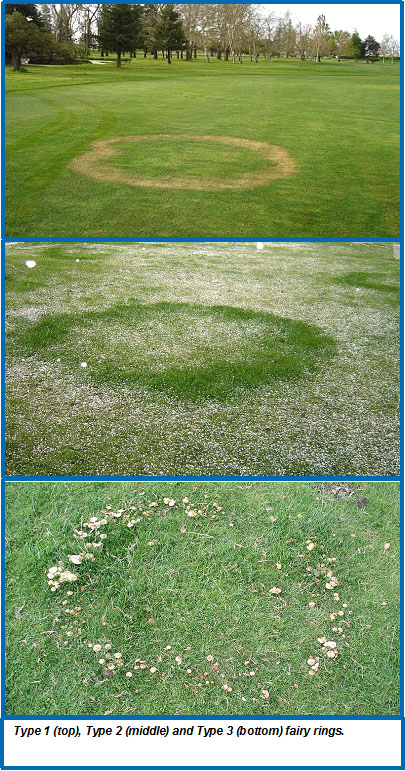
How do mushroom rings affect grass? Under the standard international classification of fairy rings in turf, they are generally divided into three types: Type I rings, which create bands of dead grass; Type II rings, which stimulate turf growth; and Type III rings, which produce fruiting bodies only. [3]
Type I Mushroom Rings
A typical fungus behind this type is Marasmius oreades, also known as the fairy ring mushroom. These rings often produce a circular band of yellowed, wilted, or even bare turf where the mycelium is active. A belt of lush, dark-green grass may also appear inside or outside the dead band because hyphae at the edge break down organic matter in the soil and release nutrients that feed the turf.

This fungus can form a thick, dense layer of mycelium in the soil. The hyphae and the hydrophobic substances they produce reduce the soil’s permeability, making parts of it difficult to wet. Even when it rains, water may be unable to pass through the mycelial layer and reach the grass roots, leaving the turf short of water.
Water stress is not the only cause of turf death; several factors are involved. One study found that each gram of soil near a Marasmius oreades ring contained about five times as much cyanide as soil 125 cm away. Because the soil is also drier where the ring’s mycelium is dense, the two effects combine to raise the cyanide concentration ninefold, inhibiting root growth [6]. Another study found changes in nitrogen, potassium, sulfur, electrical conductivity, and other properties of soil in the dead zones of Type I rings [3]. Dead turf is therefore the combined result of fungal effects on soil moisture, physical properties, and the chemical environment.
Type II Mushroom Rings
Represented by Chlorophyllum molybdites, or the green-spored parasol, these rings create a band of darker, more vigorous grass without an obvious strip of dead turf.
The lush grass grows for much the same reason as the vigorous bands associated with Type I rings. As some fungi break down dead grass, roots, and other organic matter in the soil, they release nutrients. Plants are particularly responsive to nitrogen-containing compounds, so localized nitrogen enrichment near the active mycelium makes the grass darker green and more vigorous, producing a distinct green ring in the lawn.

Type III Mushroom Rings
These rings simply and quietly produce a circle of fruiting bodies, with almost no visible effect on the surrounding turf. That does not mean there is no mycelial activity underground. Its effect on the turf’s water and nutrients may simply be too small to notice, or its positive and negative effects may cancel each other out.
Notably, the same fungal species can produce different types of ring in different environments. A ring’s particular appearance depends on the fungal species, soil conditions, water availability, and turf-management practices.
As its leading edge grows, a mushroom ring expands outward year by year at a rate that varies with fungal species and environmental conditions. A study of 304 rings formed by eight fungal species found annual expansion rates of about 0.131–0.364 meters. The rings surveyed ranged from 4 to 272 meters in diameter and were estimated to be 15–522 years old, although 90% were younger than 80 [4]. Some can persist underground for decades, while a few large mushroom rings live for an astonishing several centuries.
In European folklore, mushroom rings were once said to be traces left by elves or fairies dancing at night—hence the name “fairy ring.” On the grasslands of China, herders learned long ago to look for mushroom rings when gathering Leucocalocybe mongolica, a rare delicacy. [5]
A Special Warning
Common ring-forming species such as Chlorophyllum molybdites are among the poisonous mushrooms most often eaten by mistake in China. Chinese internet users have nicknamed it the “ICU mushroom.” Within hours of ingestion, it can cause acute gastrointestinal symptoms including nausea, repeated vomiting, abdominal pain, and diarrhea. Severe cases may involve dehydration, electrolyte imbalances, and even hypovolemic shock due to substantial fluid loss.
The next time you encounter a mushroom ring, feel free to examine its shape and the changing color of the surrounding grass—but do not pick and eat the mushrooms. Wild mushrooms are extraordinarily diverse, and color, smell, location, or signs of insect feeding cannot reliably tell you whether a fungus is poisonous.
Finally, you may wonder whether mushroom rings are entirely harmful. Although they are considered a common turf disease, in natural grasslands they can alter the local distribution of water, nutrients, and microorganisms in the soil, thereby affecting the growth of neighboring plants and the succession of the plant community. Even a small mushroom, it seems, can act as an “ecosystem engineer.”
An Aside
In deserts in arid regions such as Namibia, one can find regularly spaced circular patches of bare soil. These patches are usually called “fairy circles,” which are also occasionally translated into Chinese using the same term as fairy rings. To avoid ambiguity, this article consistently uses “mushroom ring,” rather than “fairy ring,” for rings made by fungi. The “fairy circles” of the desert are different from the mushroom rings discussed here, and their origin remains disputed, with hypotheses ranging from termite activity to self-organizing competition among plants.

The author came across this mushroom ring today while walking past the school lawn after class; the mushrooms pictured are Chlorophyllum molybdites. Players of Sky: Children of the Light may find the image familiar. Similar mushroom rings once appeared on the Daylight Prairie map, around 2020 or 2021. They appeared only at fifty minutes past every hour and lasted ten minutes each time.


References
[1] Salvatori N, Moreno M, Zotti M, et al. Process based modelling of plants–fungus interactions explains fairy ring types and dynamics. Scientific Reports, 2023, 13: 19918.
[2] Zotti M, Bonanomi G, Mancinelli G, et al. Fungal fairy rings: history, ecology, dynamics and engineering functions. IMA Fungus, 2025.
[3] Fidanza MA. Characterization of soil properties associated with type-I fairy ring symptoms in turfgrass. Biologia, 2007, 62: 533–536.
[4] Miller SL, Gongloff A. Size, age, and insights into establishment, dynamics and persistence of fairy rings in the Laramie Basin, Wyoming. Fungal Ecology, 2023, 65: 101272.
[5] Wikipedia. Leucocalocybe mongolica [EB/OL]. https://zh.wikipedia.org/wiki/蒙古白丽蘑
[6] Blenis P V, Chow P S, Duncan I, et al. Cyanide levels near fairy rings affect the growth of grasses and fungi[J]. Canadian Journal of Botany, 2004, 82(9): 1324-1329. DOI:10.1139/b04-079.
 爱发电(点击图片跳转)