Why is the Moon full on the sixteenth rather than the fifteenth?
“The Moon of the fifteenth is full on the sixteenth.” Is this really just a catchy old saying? Why does this year’s Mid-Autumn full moon actually fall on the seventeenth? Through the Moon’s orbit, the synodic month, the Chinese calendar, and Mid-Autumn customs, this article explores the astronomy and millennia of calendar-making behind a full moon.
Author: Einstein.?
Reviewed by: 星海中的蓝玫瑰
Introduction: A question behind an old saying
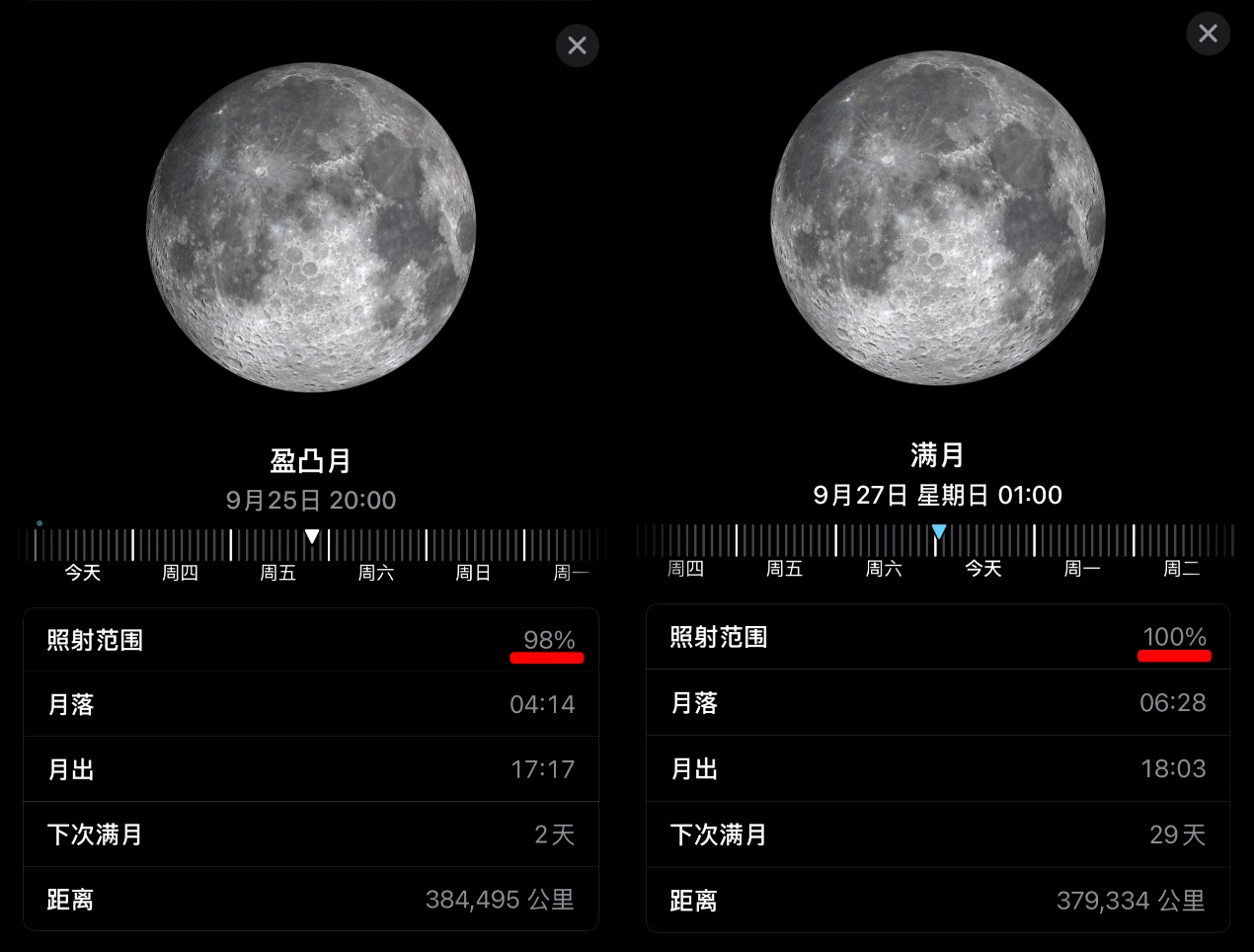
The Mid-Autumn Festival is approaching: a time to gather with family and admire the bright full moon overhead. But wait—is it really a full moon? Looking it up, we find that the Moon on the fifteenth day of the eighth lunar month this year is waxing gibbous, with 98% illumination. It is full on the seventeenth, with 100% illumination. It seems that this year’s Mid-Autumn Festival does indeed fit the old saying, “The Moon of the fifteenth is full on the sixteenth.” But why the sixteenth in particular? Behind this lies a precise set of rules involving the Chinese calendar, the Moon’s orbit, and time. To explain them, we need to start with the Moon itself.
1. Why the Moon waxes and wanes
First, the Moon does not produce its own light. The moonlight we see is sunlight reflected by the Moon. As the Moon orbits Earth, the relative positions of the Sun, Earth, and Moon keep changing. The portion of the Moon’s illuminated surface that we can see changes too. These are the phases of the Moon.
In a complete lunar cycle as seen from the Northern Hemisphere, there are four key stages.
New moon (shuo): The Moon moves between the Sun and Earth, and the hemisphere facing us is largely in darkness. It is almost invisible from Earth. This day is designated the first day of the lunar month.
First quarter: As observed from the Northern Hemisphere, about seven and a half days after new moon, the Moon, Earth, and Sun form approximately a right angle. We see the right half of the Moon illuminated, forming a semicircle, around the seventh or eighth day of the lunar month.
Full moon (wang): Earth is between the Sun and Moon, and the Moon’s illuminated face points entirely toward Earth. The round Moon is visible throughout the night, usually on the fifteenth or sixteenth day of the lunar month.
Last quarter: As observed from the Northern Hemisphere, about seven and a half days after full moon, the Moon, Earth, and Sun once again form approximately a right angle. We see the left half of the Moon illuminated, around the twenty-second or twenty-third day of the lunar month.
From new moon to full moon and back to the next new moon is one complete cycle of lunar phases.
2. The synodic month: The basis of a lunar-calendar month
The average time from one new moon to the next is called a synodic month. It is about 29.53059 days, or roughly 29 days, 12 hours, and 44 minutes.
This number has two important characteristics.
First, it is not a whole number. Because 29.53 days is not a whole number, a lunar-calendar month can only have 29 or 30 days. This is why the calendar has short months and long months.
Second, it is not constant. The actual length of a synodic month fluctuates. Different sources give slightly different extremes because their calculation models and time spans differ; it can usually be approximated as 29.5 days. The reasons are that the Moon’s orbit around Earth is elliptical, so its speed varies; Earth’s orbit around the Sun is also elliptical, and its orbital speed varies too. In addition, the relative positions of the Sun, Earth, and Moon constantly change, making their gravitational interactions complex. Consequently, the actual interval between new moon and full moon is different every month.
3. How the Chinese calendar works: New moon sets the month, full moon sets its roundness
We can summarize the rules of the Chinese calendar in a few points.
The first day must contain the new moon. The calendar defines the day containing the instant of new moon as the first day of the month.
The length of the synodic month determines whether a month is short or long. If the interval from one new moon to the next is 29 days, the month is short; if it is 30 days, the month is long.
Full moon has no fixed calendar date. The calendar fixes only new moon to the first day. The date of full moon follows naturally. Because the average interval from new moon to full moon is about 14.77 days, and new moon can occur at any time on the first day, observations show that full moon usually falls on the fifteenth or sixteenth.
Leap months adjust the length of the year. Twelve synodic months total about 354 days, roughly 11 days short of the 365.24-day tropical year. Without an adjustment, Lunar New Year would arrive progressively earlier, eventually even falling in summer. The calendar therefore adds a leap month every few years to bring its average year length close to the tropical year.
4. Why full moon does not always fall on the fifteenth
The date of full moon mainly depends on two variables.
Variable one: The exact time of new moon on the first day. If new moon occurs in the early hours of the first day, 14.77 days later will still be around the fifteenth, making the Moon full on the fifteenth. If new moon occurs in the evening or late at night, then 14.77 days later will already be past the fifteenth and into the sixteenth, giving us a full moon on the sixteenth.
Variable two: The actual interval from new moon to full moon. The Moon’s orbit around Earth is elliptical. It moves faster when closer to Earth and slower when farther away. If the Moon happens to be moving through a slower part of its orbit during the half-month from new moon to full moon, it will reach the full-moon position later than average, making the sixteenth more likely. Conversely, if it moves quickly along this stretch, full moon may arrive on the fifteenth or even the fourteenth.
Together, these two variables make the full-moon date vary between the fourteenth and seventeenth. Statistically, the sixteenth is most common, followed by the fifteenth. The seventeenth occurs occasionally, and the fourteenth is very rare. The way dates are divided in the lunar month also matters: the time of new moon on the first day, and the actual time elapsed from new moon to full moon, affect when full moon occurs. So “The Moon of the fifteenth is full on the sixteenth” is not an arbitrary saying. It reflects a statistical tendency: full moon on the sixteenth is slightly more common than on the fifteenth. But this is only a slight advantage, not a rule that “the Moon must be fuller on the sixteenth than on the fifteenth.”
5. The difference is hard to see with the naked eye
Some readers may wonder: is there any visible difference between a waxing gibbous moon with 98% illumination and a full moon with 100% illumination? In fact, the difference to human eyes is tiny. It is almost impossible to tell which is rounder. Only precise astronomical calculation and observation can determine the exact moment of full moon.
“Fullest” does not necessarily mean “brightest to the naked eye.” The Moon’s apparent brightness also depends on the Earth–Moon distance, the lunar surface’s reflectivity, the transparency of Earth’s atmosphere, and its altitude in the sky. Astronomically, “full moon” is primarily defined by geometry, not simply ranked by apparent brightness.
6. New and full moon mean more than lunar phases
New and full moon are not just stages of the lunar cycle. They are closely connected to many natural phenomena and cultural traditions.
Solar eclipses occur at new moon. At new moon, the Moon is between the Sun and Earth. If all three line up exactly, the Moon blocks the Sun, creating a solar eclipse. But the Moon’s orbital plane is tilted by about 5° relative to Earth’s orbital plane, so not every new moon brings a solar eclipse. An eclipse occurs only when new moon is near an orbital node.
Lunar eclipses occur at full moon. At full moon, Earth is between the Sun and Moon. If all three line up exactly, Earth blocks the sunlight falling on the Moon, creating a lunar eclipse. Likewise, not every full moon brings a lunar eclipse.
New moon, full moon, and tides. At new and full moon, the Sun, Earth, and Moon lie roughly in a straight line. The Sun’s and Moon’s tide-generating forces reinforce each other, producing spring tides. This is why the tidal range is greatest around the first and fifteenth days of the lunar month. At first and last quarter, the Sun’s and Moon’s tide-generating forces act at right angles and partially cancel each other, producing neap tides.
7. The origins of the Chinese calendar
The Chinese lunar calendar is, more precisely, a lunisolar calendar. It gradually took shape over more than a thousand years, developing from observation of the heavens into a scientific calendar.
Before a calendar in the true sense existed, there was a long period of determining the seasons through celestial observations. People observed where particular stars appeared in the sky at dusk or dawn to identify the seasons and guide farming. The “Canon of Yao” in the Book of Documents records that Emperor Yao sent observers in four directions to watch the stars, using four seasonal culminating stars to determine the spring equinox, summer solstice, autumn equinox, and winter solstice. The Xia Xiaozheng, China’s earliest surviving agricultural almanac, records celestial phenomena, seasonal changes in nature, and farming activities across 12 months.
The earliest calendar for which we currently have written evidence dates to the Shang dynasty. Oracle-bone inscriptions from this period already record day numbering with heavenly stems and earthly branches, long and short months, and leap months inserted at year-end. These show that the basic rules of a lunisolar calendar were already established in the Shang dynasty.
The Spring and Autumn and Warring States periods brought major advances. One was the discovery of seven leap months in nineteen years: 19 tropical years and 235 synodic months are almost equal in length. Inserting 7 leap months in 19 years keeps calendar years broadly aligned with tropical years. Another was determining the winter solstice by measuring shadows with a gnomon. Measuring the length of the noon shadow allowed people to locate the winter and summer solstices accurately and use the month containing the winter solstice as the calendar’s starting point.
What truly established the form of the Chinese lunar calendar that would remain in use for over two thousand years was the Taichu calendar, promulgated in 104 BCE. It established principles including beginning the year with the first lunar month, inserting a leap month when a month lacked a principal solar term, and incorporating the twenty-four solar terms into the calendar. A unified set of rules finally wove together “using the Moon to mark months” and “using the Sun to mark years.”
The Chinese calendar continued to be refined. The Eastern Han Qianxiang calendar first recognized variations in the Moon’s speed; the Southern Dynasties Daming calendar first introduced precession; the Tang Dayan calendar adopted the Sun’s actual position to determine solar terms; and the Yuan Shoushi calendar calculated the tropical year as 365.2425 days, exactly the value used in the present Gregorian calendar, but about three hundred years earlier. The basic lunisolar framework, however, never changed.
8. Why the Mid-Autumn Festival falls on the fifteenth day of the eighth month
A year has twelve or thirteen full moons. Why choose the one in the eighth lunar month, in autumn, for the Mid-Autumn Festival?
First, the Moon on the fifteenth day of the eighth month is no rounder than in other months. Every month has a full moon, and their roundness is much the same. What truly sets this date apart is its significance in human life.
In farming, the eighth month is a key period for the autumn harvest. Afterward came the tradition of thanksgiving offerings: people offered sacrifices to the gods of the land and grain to thank them for their protection and celebrate the harvest. Around the fifteenth of the eighth month, farm work eased a little, giving people time and the inclination to gather, drink, and admire the Moon.
In seasonal conditions, autumn brings clear skies and crisp air. The northern rainy season is over, humidity is lower, visibility is high, and clouds are few. The Moon’s rising position and altitude after dusk suit all-night viewing. Temperatures are pleasant, neither too cold nor too hot, making outdoor moon-viewing and feasting comfortable. The Moon is not rounder in the eighth month; the weather is simply best for looking at it.
Astronomically, the Mid-Autumn Festival usually falls around the autumn equinox. Full moons around that time have a particular feature: they rise almost as soon as the Sun sets, remain visible all night, and reach a moderate altitude. For people in ancient times whose activities centered on dusk, “the Sun sets and the Moon rises” was the most convenient moment for observation and ceremonies.
Historically, moon worship and autumn thanksgiving existed before the Qin dynasty, and the term “mid-autumn” already appeared in the Rites of Zhou. The Han dynasty had autumn earth-god festivals and moon worship. The Tang dynasty was a crucial period in the festival’s formation: society was stable, poetry flourished, and moon-viewing became fashionable. In the Song dynasty, reunion became the central theme, and mooncakes began to serve as a seasonal food. During the Ming and Qing dynasties, mooncakes and family reunions became established customs that continue today.
Compare full moons in other months: the fifteenth of the first month is the Lantern Festival, centered on lanterns; the fifteenth of the seventh month is the Ghost Festival, centered on ancestor worship; by the fifteenth of the ninth month, autumn is deepening and growing cold; and by the fifteenth of the tenth month it is already winter, making moon-viewing less enjoyable. The fifteenth of the eighth month wins out because it combines leisure after the harvest, good weather for moon-viewing, favorable astronomical conditions near the autumn equinox, and a reunion theme gradually acquired through history.
9. Moon festivals around the world
The Moon holds special meaning in many cultures. Beyond the Mid-Autumn Festival familiar to us, many countries have festivals associated with the Moon.
In Asia, one of South Korea’s most important festivals is Chuseok, also on the fifteenth day of the eighth lunar month. People return home for family reunions, honor their ancestors, and eat songpyeon rice cakes. Its importance rivals that of Lunar New Year. Japan’s moon-viewing festival was also influenced by the moon-viewing culture of Tang China and later developed into the distinctively Japanese tradition of tsukimi. People arrange pampas grass and moon-viewing dumplings indoors or on verandas as offerings to the moon deity, and the whole family admires the Moon together. Vietnam’s Mid-Autumn Festival also falls on the fifteenth of the eighth lunar month, but it is regarded as a children’s festival too. Children play with carp-shaped lanterns, symbolizing “leaping the Dragon Gate.” Sri Lanka’s full-moon festival is particularly distinctive: it is celebrated every month at full moon, with a nationwide holiday. The full-moon festival around Mid-Autumn is the grandest of all.
Although their names and customs differ, these festivals all express people’s hopes for nature, harvests, and reunion.
10. Closing thoughts
As the Moon moves toward fullness, we draw closer to the Mid-Autumn Festival day by day. The next time you look up at the Moon, perhaps you will remember that behind its round face lie not only the poetry of reunion, but also the precise rhythm of the synodic month, changes in speed along its elliptical orbit, and more than two thousand years of Chinese calendar history. That, too, is a romance unique to autumn~
 爱发电(点击图片跳转)