
Gaia Reveals How Dead Sun-Like Stars Crystallize
Author: A Millisecond of Eternity
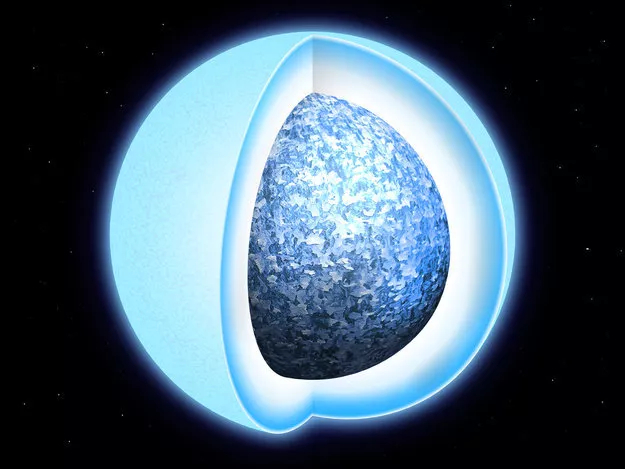
On January 9, 2019, data from Gaia, the European Space Agency’s Milky Way–mapping spacecraft, revealed for the first time how white dwarfs, the dead remnants of stars like our Sun, crystallize into solid spheres as their hot interiors cool.
Scientists predicted the solidification, or crystallization, of matter inside white dwarfs 50 years ago. Only with Gaia, however, have astronomers been able to observe enough white dwarfs precisely enough to see the telltale pattern.
“Before Gaia, we had distances for only a few hundred white dwarfs, and many of them were in clusters where they all had the same age,” said Pier-Emmanuel Tremblay of the University of Warwick in the United Kingdom, lead author of the study published in Nature. “With Gaia, we now have distances, brightnesses, and colors for hundreds of thousands of white dwarfs—a substantial sample across the Milky Way’s outer disk, covering a range of initial masses and ages.” Gaia’s precise distance measurements were the breakthrough, allowing astronomers to determine the stars’ true brightness with unprecedented accuracy.
On a truly cosmic scale, M100 is a magnificent grand-design spiral galaxy. It contains more than 100 billion stars and has well-defined spiral arms like those of our Milky Way. Also known as NGC 4321, M100 is one of the brightest members of the Virgo Cluster. It lies in the direction of the constellation Coma Berenices, about 56 million light-years away. This recent Hubble Space Telescope image, taken with Wide Field Camera 3, highlights the bright blue star clusters and intricate, winding dust lanes characteristic of such galaxies. Studies of variable stars in M100 have played an important role in determining the size and age of the universe.
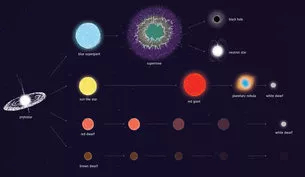
White dwarfs are the remnants of medium-sized stars like the Sun. Once such a star exhausts the nuclear fuel in its core, it sheds its outer layers and leaves behind a hot core that slowly cools. These ultradense remnants continue to emit thermal radiation, although they appear faint to astronomers. An estimated 97% of the stars in the Milky Way will ultimately become white dwarfs, while more massive stars end as neutron stars or black holes. White dwarfs take billions of years to cool. Once they reach a certain temperature, the formerly incandescent matter in the core begins to crystallize and turn solid. The process resembles liquid water freezing at zero degrees Celsius on Earth, except that a white dwarf solidifies at the extraordinarily high temperature of roughly 10 million degrees Celsius. For this study, astronomers analyzed more than 15,000 candidate stellar remnants observed by Gaia within 300 light-years of Earth and found that the crystallizing white dwarfs formed a distinctive group.
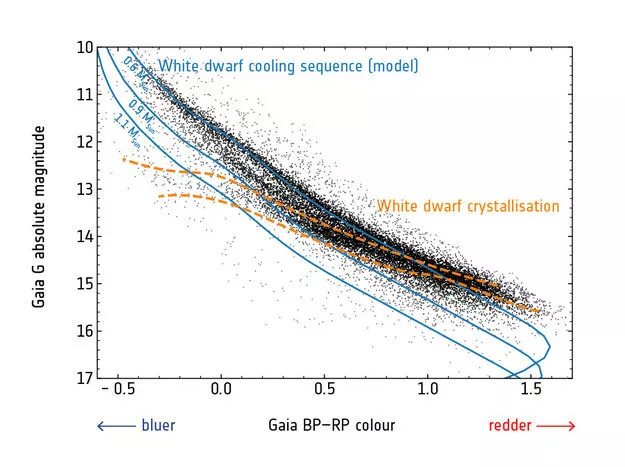
“We saw a concentration of white dwarfs with particular colors and brightnesses that were not related through their evolutionary histories,” Pier-Emmanuel said. “We realized that this was not a distinct population of white dwarfs, but the effect of cooling and crystallization predicted 50 years ago.” The heat released during crystallization, a process that lasts billions of years, appears to slow the evolution of white dwarfs. The dead stars stop fading and therefore look two billion years younger than they really are. That, in turn, changes our understanding of the stellar populations to which they belong. “White dwarfs are commonly used to determine the ages of stellar populations such as star clusters, the outer disk, and the Milky Way’s halo,” Pier-Emmanuel explained. “We must now develop better crystallization models to estimate the ages of these systems more accurately.”
Not all white dwarfs crystallize at the same rate. More massive white dwarfs cool faster and reach the crystallization temperature in about one billion years. Lower-mass white dwarfs, which more closely resemble the Sun’s expected final state, cool more slowly and take six billion years to become solid spheres. The Sun has about five billion years left before it becomes a white dwarf, and astronomers estimate that it will take another five billion years after that to cool into a “crystal ball.”
“This result highlights Gaia’s versatility and its many applications,” said Timo Prusti, ESA’s Gaia project scientist. “It is exciting that scanning the stars across the sky and measuring their properties can demonstrate the existence of plasma phenomena in matter at densities so extreme that they cannot be tested in a laboratory.”
Article Source
 爱发电(点击图片跳转)