
Black Holes Are Fascinating—So Why Are Their Names So Dull?
Author: 一毫秒的永恒
A Name Fit for Poetry
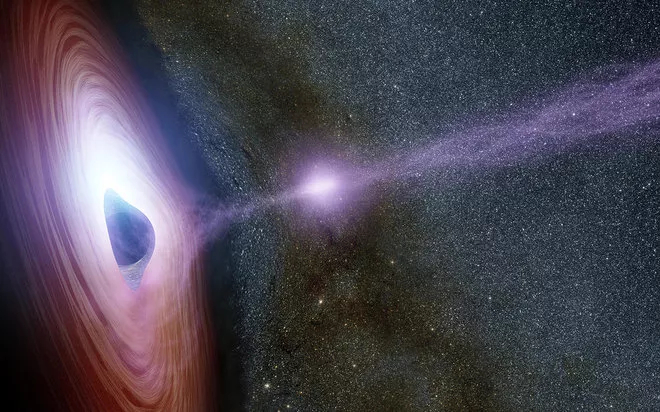
Credit: NASA/JPL-CalTech
On April 10, 019, the first image of M87*, a black hole 55 million light-years from Earth, was released. It also received a name far more interesting than those of most black holes. This may have been the first stroke of naming luck in black-hole history: its new name was “Pōwehi,” a word in the Indigenous Hawaiian language meaning “embellished dark source of unending creation.” The name came from Larry Kimura, a professor and Hawaiian-language expert at the University of Hawaiʻi at Hilo.

Source: Daily Mail, UK
In a statement, Kimura said of naming the black hole, “As a Hawaiian, it is wonderful that we can connect to an identity from long ago, as sung in the chant ‘Kumulipo,’ and bring this precious heritage into our lives today.” He added, “To have the privilege of giving it a Hawaiian name just after the first image of a black hole on the scale of its event horizon was obtained is deeply meaningful to me and to my Hawaiian ancestry. I hope we can continue naming future black holes from the ‘Kumulipo’ chant.”
The word “Pōwehi” comes from Kumulipo, an eighteenth-century chant recounting the creation of the Hawaiian cosmos. In the chant, “pō” and “wehi” describe concepts associated with the creation of the Hawaiian universe. The EHT project used eight millimeter-wave radio telescopes distributed around the world, two of them located on the dormant Mauna Kea volcano in Hawaiʻi. The discovery of the black hole at the center of the M87 galaxy also made use of the 8.1-meter Frederick C. Gillett Gemini telescope on Mauna Kea. Kimura therefore gave the black hole a Hawaiian name.
“Embellished dark source of unending creation” certainly stirs the imagination more than this black hole’s original name—or the names of other black holes. Experts told Live Science that the black hole shown in the image lies at the center of the Messier 87 (M87) galaxy and is usually called “M87*,” with the asterisk indicating that it occupies the galactic center.
M87* has other names, all similarly monotonous strings of letters and numbers: NGC 4486, UGC 7654, Arp 152, and 3C 274. These designations are meaningful to astronomers, but they do not stir the imagination like the names of planets, moons, asteroids, comets, and other cosmic objects, which may call to mind gods or figures from ancient mythology. Why do some celestial bodies have such evocative names while black holes—arguably among the most mysterious and exciting phenomena in the cosmos—usually do not?
Before astronomers around the world formally accept a name for any object in space, it must be approved by the International Astronomical Union (IAU). Founded in 1919, the IAU established systems for naming celestial bodies so that objects could be identified unambiguously and everyone would know exactly which one a given research paper discussed. Although these conventions apply to stars, planets, asteroids, and other objects, black holes were not directly observed until 2019, so there is currently no naming protocol for them. Scientists had, of course, already conducted extensive theoretical research on black holes, but we still know very little about any particular one, making names a low priority.
Numbers and Codes Alone
Before the IAU was formed, most objects in space were known by numbers assigned in catalogues compiled by astronomers, such as Charles Messier’s catalogue of deep-sky objects. Messier and others recorded their observations and numbered objects in sequence; later astronomers referred to those bodies by their catalogue numbers.
The Messier catalogue, published in 1771, contains 110 objects. Its eighty-seventh entry is the M87 galaxy. Many other astronomers compiled observations of their own, with substantial overlap among their results, so the same galaxy or black hole can have several names. It can be awkward when you know one name for an object and someone else knows another; it may take a while to realize that you are discussing the same thing. The M87* black hole, however, is now so famous that the EHT team at Haystack Observatory simply calls it “M87,” or occasionally “3C274.”
What Is in a Name?
Michael Shara, a curator and professor in the Department of Astrophysics at the American Museum of Natural History in New York, said, “Over time, observations with increasingly sensitive instruments have produced a growing number of objects suspected to be black holes. Those without catalogue names are usually identified by their coordinates in space—the equivalent of longitude and latitude in the sky, namely right ascension and declination.” Shara continued, “These coordinate ‘names’ also include letters at the beginning to show which satellite located the black hole. For now, this is the most practical means of identification, because there are currently millions of X-ray sources that could represent supermassive black holes.”
Fish noted, however, that celestial objects had received evocative names before, in addition to astronomers’ strings of letters and numbers. The M104 galaxy, for example, is commonly known as the Sombrero Galaxy because its shape resembles a sombrero. The horse-like appearance of the Barnard 33 nebula likewise earned it the name Horsehead Nebula.
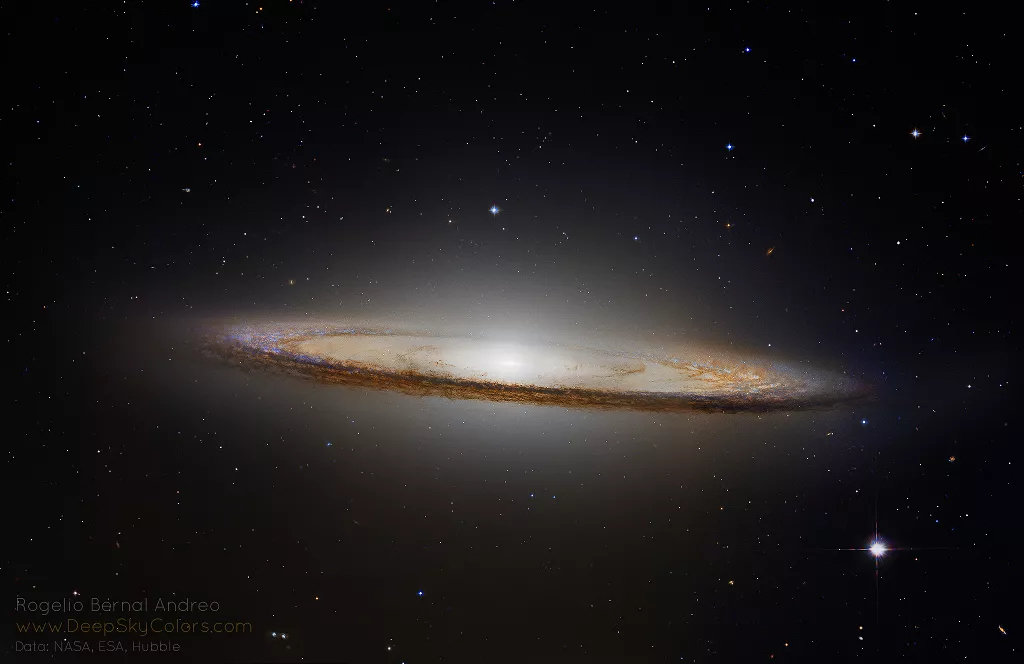
Image Data: NASA, ESA, Hubble Legacy Archive;
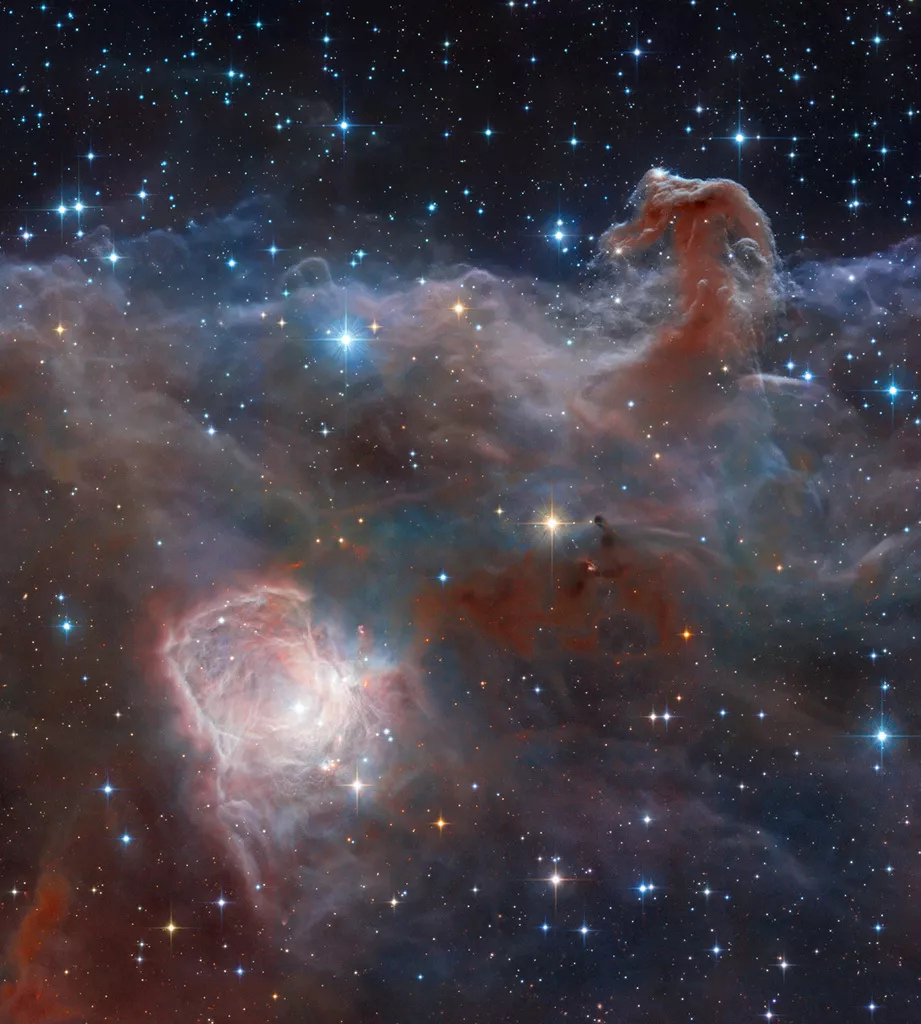
Image Data: ESO, VISTA, HLA, Hubble Heritage Team (STScI/AURA)
Now that the EHT has shown that black holes can be imaged directly, perhaps the time has come for astronomers around the world to reconsider how they should be named. Shara nevertheless said, “Even if the M87 black hole’s new name, ‘Pōwehi,’ catches on, it will not be considered official without IAU recognition. If the new name is to endure, it will need the IAU’s support—but I think its chances are good, because two of the radio telescopes involved in the project are in Hawaiʻi.”
Hollis added, “If the IAU does not become involved, the final name will undoubtedly be determined by consensus in the scientific literature. We will have to wait and see.”
As time passed, however, the International Astronomical Union (IAU) did not adopt “Pōwehi” as the official name of M87*. The IAU’s naming remit still covers stars, planets, asteroids, and satellites, but not black holes. In academic literature and international databases, the black hole is still called M87*—the only recognized scientific name suitable for citation in a paper. “Pōwehi” instead became a “cultural name,” a symbol in public memory rather than an entry in a scientific catalogue.
And so, in scientists’ papers it remains “M87*”;
in the hearts of poets, the public, and children, it will always be “Pōwehi.”
A dark source named by humanity, a void illuminated by language.
References
 爱发电(点击图片跳转)