
InSight Detects the First Likely Marsquake
Author: A Millisecond of Eternity
In the early hours of April 24, 019, a magnitude 6.3 earthquake struck Medog County in Nyingchi, Tibet. The shaking was widely felt across the surrounding area, but fortunately, very few people lived within 50 kilometers of the epicenter, and no casualties were reported.
Earth has earthquakes, but do other worlds in the Solar System “quake” too? Of course. Consider our own Moon. In 1969, American astronauts first set foot on the lunar surface during the Apollo program and installed 5 seismometers. The instruments continuously transmitted records of moonquakes to Earth, opening a new field of lunar seismic research. In 2019, scientists found signs of quakes on our neighbor Mars as well.
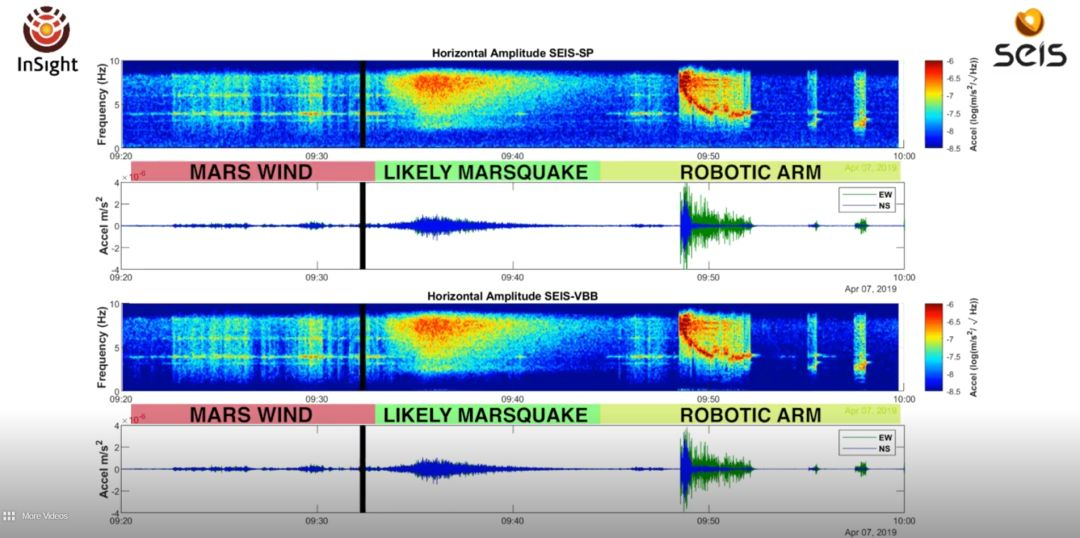
The InSight lander’s Seismic Experiment for Interior Structure (SEIS) detected and recorded the mysterious signal. Developed by France’s National Centre for Space Studies (CNES), the seismometer is sensitive enough to “feel” movements of the Martian surface on the scale of a hydrogen atom’s radius. It can record vibrations caused by marsquakes, Martian winds, and meteorite impacts.
On April 6, 2019, InSight’s 128th Martian day on the surface, SEIS may have captured a marsquake for the first time. It was the first vibration from inside the Red Planet that InSight had “heard,” but the signal was too weak for scientists to confirm immediately. At a press conference on April 23, CNES formally announced that InSight had detected one faint marsquake signal, along with three other possible events.
“We have been waiting months for a signal like this,” Philippe Lognonné, principal investigator for SEIS at the Institut de Physique du Globe de Paris, said in a CNES statement. “It is so exciting finally to have proof that Mars is still seismically active.”
Scientists believe marsquakes will be less frequent than earthquakes because Mars has no tectonic plates, whose interactions cause many quakes on Earth. The Martian interior, however, continues to cool and contract, building stress in the crust. When enough stress accumulates, or when a meteorite strikes the planet, the crust can fracture and produce a marsquake. Detecting such faint signals requires an exceptionally sensitive instrument protected from wind and dust. That is why a white, domed shield covers SEIS, allowing the instrument to listen undisturbed for vibrations in the ground.
The team now had its first result. On April 6, 2019, the lander’s 128th Martian day, or sol, the highly sensitive detector picked up a tiny vibration from inside Mars. NASA referred to it as the Sol 128 event. Three similar signals had been measured on March 14, April 10, and April 11, but they were even weaker and their origins less certain. Exciting as the detection was, it could not yet fulfill InSight’s ultimate goal of probing the Martian interior: the quake was too weak to produce the data needed for that analysis.
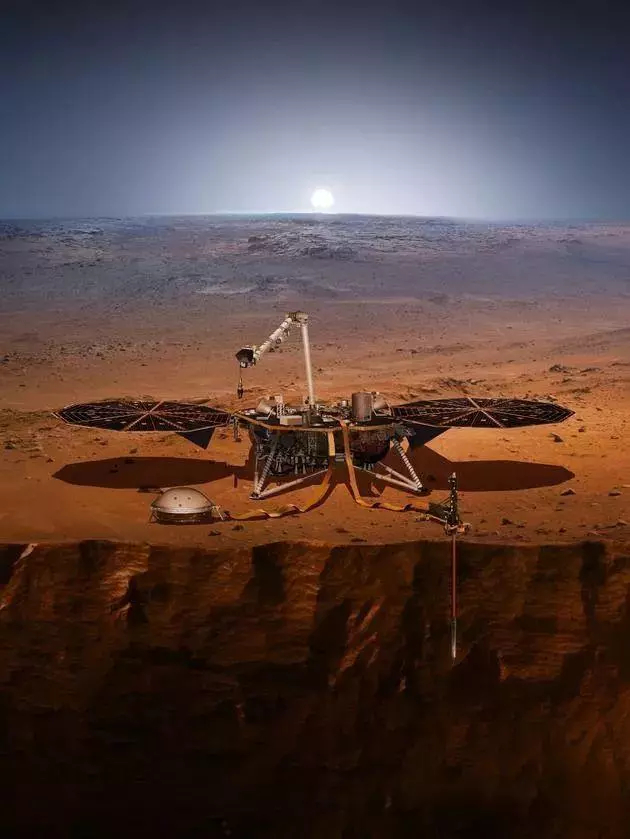
The InSight team had other ways to gather data. The Heat Flow and Physical Properties Package (HP3), nicknamed the “mole,” would take Mars’s “temperature,” while the Rotation and Interior Structure Experiment (RISE) would study the planet’s motion and the size of its core. The roughly 40-centimeter-long mole, however, ran into trouble. Its self-hammering spike was designed to burrow about 5 meters below the surface and gather important information about the Martian interior, but it encountered a serious problem after digging less than 50 centimeters. Scientists initially suspected that it had struck a large rock. Later analysis showed that the main difficulty was insufficient friction from the surrounding soil. They built a replica on Earth and tried to diagnose and solve the problem, but without success.
InSight placed SEIS directly on the Martian surface, making it a successor to the lunar seismometers installed by Apollo astronauts. The year 2019 marked 50 years since the United States placed seismometers on the Moon through the Apollo program.
“The activity from the Sol 128 signal is very exciting,” said Lori Glaze, director of NASA Headquarters’ Planetary Science Division. “Its size and duration match the profile of moonquakes detected on the lunar surface during the Apollo missions.” Bruce Banerdt, a geophysicist at NASA’s Jet Propulsion Laboratory and principal investigator of the InSight mission, said, “InSight has carried the Apollo program’s scientific investigations forward to Mars for the first time. Until now, we have been collecting background information about Mars. This event officially opens a new field: Martian seismology.”
References
- https://www.nasa.gov/press-release/nasa-s-insight-lander-captures-audio-of-first-likely-quake-on-mars
- https://www.space.com/insight-mars-lander-first-marsquake.html
- https://www.livescience.com/65303-scientists-detected-first-marsquake.html
- https://finance.sina.com.cn/roll/2019-04-24/doc-ihvhiewr8039838.shtml
 爱发电(点击图片跳转)