Five-Minute Immunology: How Antibodies Adapt
Author: Shenzhou
Reviewer: Dongda
We know that evolution results from the combined effects of genetic mutation and natural selection. If we ask which living things mutate fastest, bacteria and viruses are obvious candidates. Here I am using Schrödinger’s much-debated idea that life “feeds on negative entropy”; there is still no universally accepted definition of life, but that is not our subject. The status of viruses as living things also remains disputed. Bacteria and viruses are small, reproduce quickly, and in some cases carry genetic material that is structurally unstable. Most of them also cause disease in plants and animals, so we continually develop drugs to destroy them.
Yet the rapid reproduction and high mutation rates of some bacteria and viruses allow drug-resistant individuals or strains to survive the selection pressure and quickly escape the effects of a treatment. That troublesome ability is precisely why antibiotic use must now be restricted. Over the long course of evolution, however, animals have developed countermeasures against pathogens. Together, these mechanisms form the immune system. Its power means that we do not have to compete with pathogens at the cost of our own lives. If we had to match their rates of reproduction and evolution directly, the outcome would be brutal.
How, then, does the immune system let an individual respond without being sacrificed so that the larger population can survive?
If the rapid changes in a pathogen’s antigens result from continual random mutations in the nucleotide sequences that encode them, you might guess that the immune system also produces antibodies through random changes in genetic code. Before answering that question, we need a rough picture of an antibody’s structure.
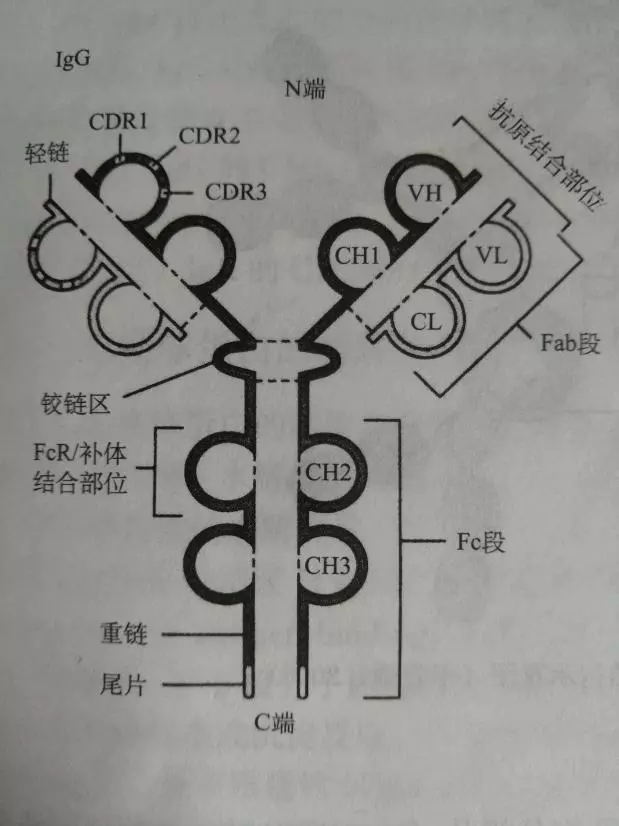
Take an IgG antibody as an example. The white chain in the diagram is the light chain, or L chain, which contains about 214 amino acids. The dark-blue section is the heavy chain, or H chain, with roughly 500 amino acids. The upper end is the amino terminus, or N-terminus; the lower end is the carboxyl terminus, or C-terminus.
Most of an antibody’s amino-acid sequence is fixed and relatively stable. This portion is called the constant region, or C region. Near the N-terminus, however, about 110 amino acids form a highly variable segment capable of enormous diversity. This is also the main part of the antibody that binds an antigen, so it is known as the variable region, or V region. In effect, this region takes on the task of “mutation and evolution” directed at antigens instead of requiring the entire organism to do so. Its many possible variations produce antibodies with a vast range of specificities, enough to recognize almost any antigen and keep pace as pathogens change.
Our bodies therefore contain large numbers of B cells whose surfaces carry different antibody receptors, ready to confront antigens from the outside world. When a new antigen enters the body, a vast arsenal of potential antibodies is often already waiting. The B cells that carry them patrol throughout the body. As soon as one encounters its matching antigen, the receptor binds to it and activates that B-cell population to proliferate and differentiate. Once a weapon proves effective, production is immediately scaled up until the invading force has been eliminated.
In this way, the immune system gives an individual the ability to adapt rapidly to new pathogens within a single lifetime, helping us hold our own in the struggle against infection. By now, you can probably sense how powerful that system is. Yet this is only one small part of its many mechanisms. There are many more ingenious functions to explore, and this series will continue to examine them.
 爱发电(点击图片跳转)