
The Twelve Zodiac Signs and the Thirteen Zodiac Constellations
Author: Congyu
The twelve zodiac signs and the thirteen zodiac constellations have long been confused with each other, especially by people who are not astronomy enthusiasts. For a variety of reasons, the zodiac constellations used today differ greatly from the ancient zodiacal signs. This article offers a brief introduction and explains the distinction between them.
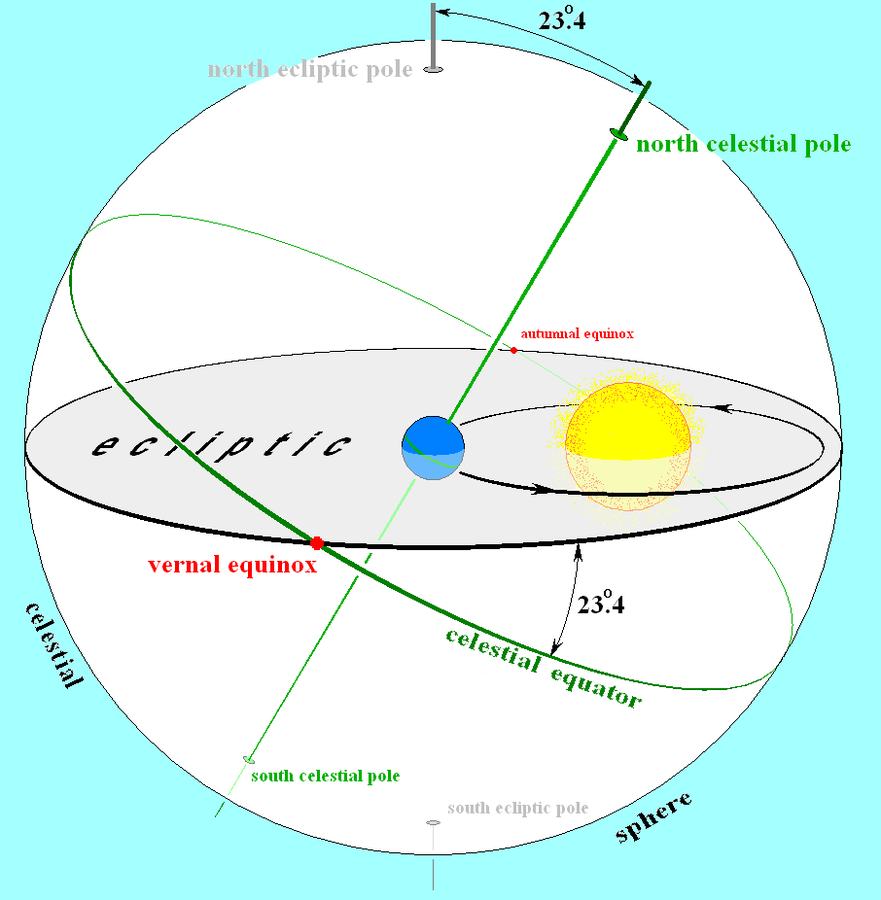
Before discussing the twelve signs and the zodiac constellations, it helps to explain the “ecliptic.” The plane of Earth’s orbit around the Sun is called the ecliptic plane. Extending that plane until it intersects the celestial sphere produces the great circle known as the ecliptic. Put another way, the ecliptic is the path traced by the Sun’s apparent annual motion across the celestial sphere. What does this annual apparent motion mean? If we disregard Earth’s rotation—supposing that Earth did not rotate—and consider only its revolution around the Sun, the Sun’s year-long path across the sky would be the ecliptic. Both the zodiac constellations and the zodiacal signs are divided along this path.
The Twelve Zodiacal Signs
Strictly speaking, the twelve zodiac signs should perhaps not be treated as an astronomical concept, because they are actually part of Western astrology. Their origins date back to the establishment of the Neo-Babylonian Empire, around 626 BCE, so this article will not discuss them in great detail.
Beginning at the vernal equinox, astrologers divided the ecliptic from west to east into twelve equal sections. Each sign spans 30 degrees of the sky, so the Sun remains in each one for roughly a month, with slight variations caused by the uneven speed of Earth’s revolution. The dates behind the popular question of which “sign” someone belongs to based on their birthday come from these twelve zodiac signs.
The Thirteen Zodiac Constellations
In 1928, the International Astronomical Union (IAU) formally divided the entire sky into 88 constellations. It defined their regions and boundaries with reference to lines of right ascension and declination based on the 1875 vernal equinox and equator. The ecliptic passes through thirteen of these constellations, as shown below:

Unlike the twelve equal zodiac signs, the number of days that the Sun spends in each constellation varies considerably, and the set includes the additional constellation Ophiuchus. The most obvious difference lies in the dates when the Sun enters and leaves each constellation. For example, the dates associated with the sign Aries are March 21 to April 20, while the Sun passes through the constellation Aries from April 19 to May 13, a difference of about one month. The mismatch between the dates of the constellations and the signs results from precession, the periodic conical wobble of Earth’s rotational axis. One mistaken claim holds that precession “added Ophiuchus to the zodiac.” In fact, precession causes the equinoxes and solstices to move slowly westward along the ecliptic, completing a cycle in 25,800 years and shifting by about one degree every 70 years. It therefore affects only the timing of the Sun’s apparent movement among the zodiac constellations; it does not alter the position of the ecliptic.
More than 2,600 years have passed since the zodiacal signs were first defined. Over that long period, precession has accumulated a discrepancy of about 36 degrees between the signs and the constellations, and the vernal equinox has long since moved from Aries into Pisces. The Gregorian calendar used today takes the Sun’s periodic motion—the tropical year—as its reference, so the vernal equinox still occurs around March 21 each year. As the equinoxes and solstices shift along the ecliptic on the celestial sphere, however, the constellation dates change gradually. It is worth noting that the summer solstice was still in Gemini a little over thirty years ago; it has now moved into Taurus. In about 600 years, the vernal equinox will also leave Pisces and enter Aquarius.
If you use Stellarium or similar software to view constellation boundaries, you will notice that many boundary lines run roughly parallel to lines of right ascension and declination but sit slightly askew from them. As noted above, the constellations were delineated with reference to the equatorial coordinate lines of 1875. Their present-day offsets in equatorial coordinates are another result of precession. Precession does not affect a celestial object’s ecliptic latitude, but it does change its ecliptic longitude and equatorial coordinates.
Any discussion of the zodiac constellations should also mention Virgo, Sagittarius, and Aquarius, three constellations whose Chinese names are often given incorrectly. Standard Chinese astronomical terminology has never used the popular astrological variants that literally mean “maiden,” “archer,” and “water bottle.” Those incorrect names may have come from direct translations of the Japanese names for the zodiac constellations. It is difficult to understand why established Chinese proper names would be replaced by secondary translations from another language.
Conclusion
Astronomy and astrology parted ways a thousand years ago. The twelve zodiacal signs belong to the pseudoscience of astrology and should be discarded; what we should retain instead is scientific thinking and accurate knowledge.
 爱发电(点击图片跳转)