
Reading the Night Sky: Constellations and Celestial Events
Author: Qingliu
Reviewer: Saito Shin
Astronomy is built on observation. From humanity’s first look at the stars to the first image of a black hole, observation gave birth to the field and has driven it forward. Modern astronomy has long since moved beyond the unaided eye, but learning how to observe remains an amateur astronomer’s first lesson. This article introduces some of the celestial phenomena encountered in observational astronomy.
Good observing begins with knowing how the sky is organized and which important phenomena appear in each region.
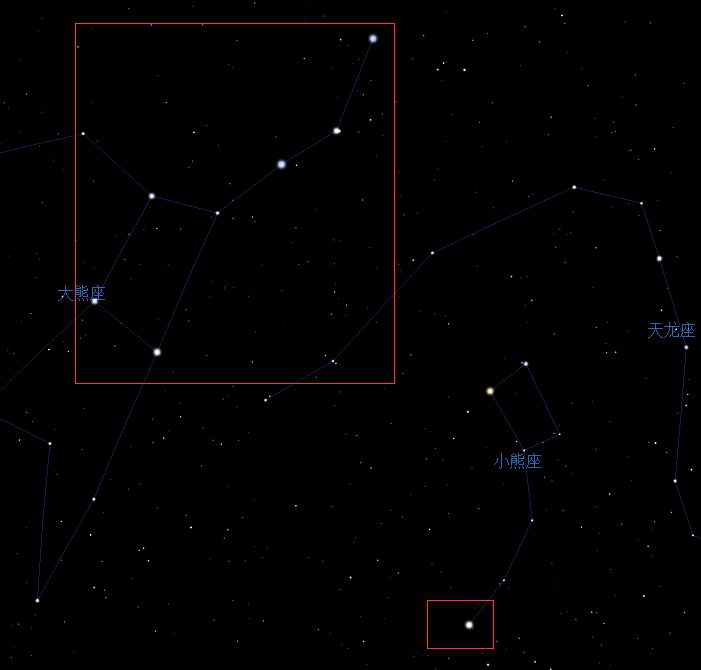
The image above shows the Big Dipper and Polaris. They are easy to locate in the northern sky once you know the latitude of your observing site. Polaris’s altitude above the horizon is equal to the observer’s geographic latitude. On a clear night, face due north and raise your gaze from the horizon by that angle. If you are at latitude 45° N, for example, look 45° above the horizon.
Once you have found them, you can use them as reference points to locate other constellations. For example:
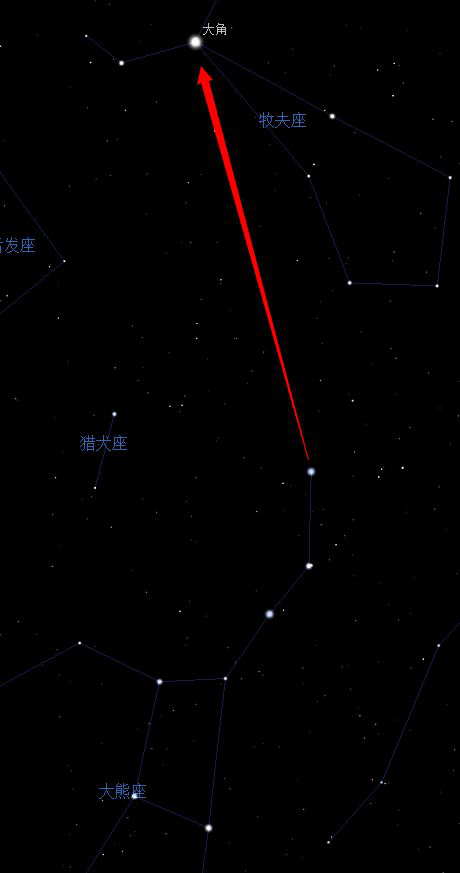
Trace the curve of the Big Dipper’s handle for roughly one bowl-length beyond the handle, and you will reach a bright star: Arcturus in Boötes. Several moderately bright stars in Boötes form a pentagon that resembles a large kite, with Arcturus hanging beneath it like a lamp. At apparent magnitude −0.04, Arcturus is the constellation’s brightest star and one of the three brightest stars in the northern sky, along with Vega and Capella. The double star Epsilon Boötis, also called Izar, was named Pulcherrima by the Russian astronomer Friedrich Georg Wilhelm von Struve; the Latin word means “most beautiful.” The system consists of an orange-yellow giant of apparent magnitude 2.70 and a blue main-sequence star of magnitude 5.12. Their strong color contrast is especially striking through a telescope. The June Bootids meteor shower is active from June 26 to July 2 and peaks on June 27. Its radiant lies at right ascension 224° (14 h 56 m) and declination +46°. The radiant is high during the first half of the night, and a 20.2-day-old Moon, two days before last quarter, causes little interference. The shower’s zenithal hourly rate (ZHR) ranges from 0 to 100, and bright meteors make up a relatively large share of the shower. Astronomers still do not understand its behavior well enough to predict the strength of each return.
The June Bootids have always been erratic. After a major outburst in 1927, they disappeared for decades, leading many astronomers to think the shower was gone. It returned with another large outburst in 1998, then began playing hide-and-seek once more. Its activity remains difficult to forecast. That mystery makes every return especially valuable to astronomers and meteor watchers, because each one offers more clues to the shower’s behavior.
The June Bootids are also described as meteors “catching up with Earth” because they move relatively slowly, at about 18 kilometers per second. Typical meteor showers travel three to four times faster, at roughly 60–70 kilometers per second.
Stellar brightness is measured in magnitudes: the smaller the number, the brighter the object. Arcturus, for example, is roughly a first-magnitude star and appears bright. The Sun has an apparent magnitude of about −26 and is far brighter, while a sixth-magnitude star looks faint to the human eye. A meteor generally brightens as it crosses the night sky, flares at its peak, and then burns out. Some fireballs reach magnitude −8 or even −10. Under good conditions, an observer with sharp eyesight may see sixth-magnitude stars; others may reach only third or fourth magnitude.
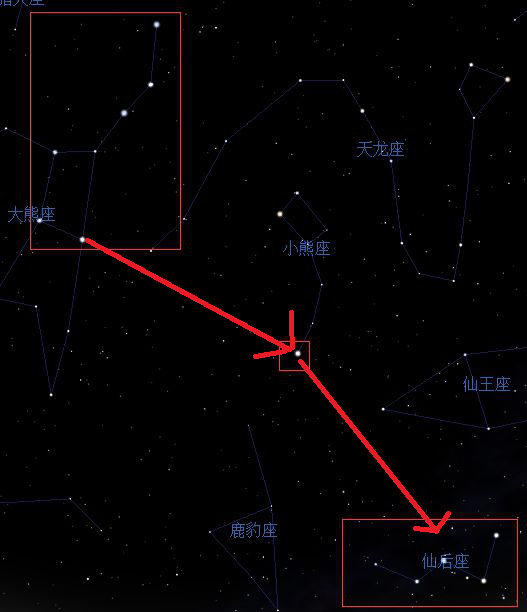
On the side of Polaris opposite the Big Dipper, and slightly offset, five bright stars form the W of Cassiopeia. The constellation rivals the Big Dipper in prominence. More than a hundred of its stars can be seen with the unaided eye under suitable conditions, although only six or seven are especially bright. Three second-magnitude stars and two third-magnitude stars form a clear capital W whose opening faces Polaris, the constellation’s main identifying feature. Another way to find Cassiopeia is to extend the line from Dubhe in Ursa Major through Polaris in Ursa Minor by roughly the same distance; it reaches Cassiopeia on the “shore” of the Milky Way. The deep-sky object M52, also known as Messier 52 or NGC 7654, is an open cluster in Cassiopeia discovered by Messier in 1774. It is visible through binoculars and makes an excellent target for deep-sky photography.
Another example:
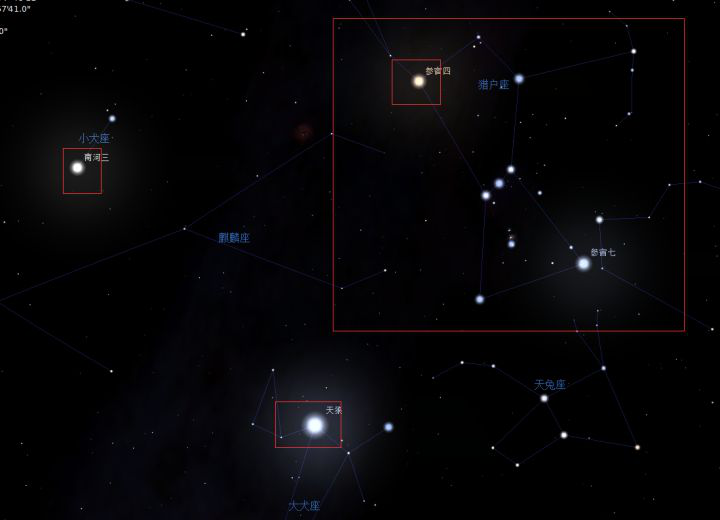
From the Eastern Hemisphere on a winter night, look south at an altitude of about 40° to find Orion inside the large box in the image. Orion’s classic outline, especially its belt, is easy to recognize, and the constellation contains many bright stars and nebulae. It is one of the richest regions in the entire sky. Orion is best observed from early December to early April. It rises in the southeast, passes across the sky, and sets in the southwest. Alpha Orionis (Betelgeuse) and Beta Orionis (Rigel) are easy to see on an ordinary clear night. Because the winter sky contains many bright stars, however, the three stars of Orion’s Belt provide a more reliable guide. Their apparent magnitudes range from 1.7 to 2.3, so they stand out under skies with little light pollution. Betelgeuse and Rigel lie at opposite ends of a line perpendicular to the belt. Once you have found them, look west of Betelgeuse for Gamma Orionis (Bellatrix) and east of Rigel for Kappa Orionis (Saiph), and Orion’s full outline emerges. Hanging from Orion’s Belt is the sword, which includes Theta¹ and Theta² Orionis and the Orion Nebula (M42); in traditional Chinese astronomy, this region is called Fa. Even without optical aid, M42 is visibly more than a point of light. Binoculars reveal its young stars, glowing gas, and dust.
A small telescope reveals still more deep-sky objects in Orion. The constellation is named for a hunter in ancient Greek mythology, and the Orion Nebula (M42) lies in his sword. M42 covers an apparent area about 5 percent as large as the full Moon’s. On a dark, clear night, it can be seen with the unaided eye as a hazy patch. About 1,500 light-years away, M42 lies in the Orion Arm of the Milky Way, the same spiral arm in which the Solar System orbits the Galactic center. The four especially bright stars at the center of the image form the Trapezium. They are the hottest and most massive stars in the nebula. Their radiation lights the surrounding gas like a flash illuminating a cavern, causing it to glow as an emission nebula.
The Orion Nebula is one of the best-known nebulae. People have watched this hazy region since antiquity, but only the invention of the telescope and the development of modern astronomy made detailed study possible.
Another famous object is the Horsehead Nebula (IC 434) near Zeta Orionis, named for the horse-head shape of its dark dust. It is difficult to see through an amateur telescope, so observers often use it as a test of their skill. One portion is an emission nebula excited by a B7-type star; another is a reflection nebula illuminated by a B7-type star. Its angular diameter is 30 arcminutes, and it lies 350 parsecs from Earth, with one parsec equal to about 3.26 light-years.
Orion also hosts a meteor shower whose radiant lies northward along the line from Zeta to Alpha Orionis, extended by the same length. The Orionids appear each year from October 17 to October 25, peak on October 21, and have a secondary maximum worth watching on October 17–18. They are produced by Halley’s Comet.
Betelgeuse and two other bright stars, Sirius in Canis Major and Procyon in Canis Minor, form the well-known Winter Triangle. It is conspicuous and easy to find in the winter sky.
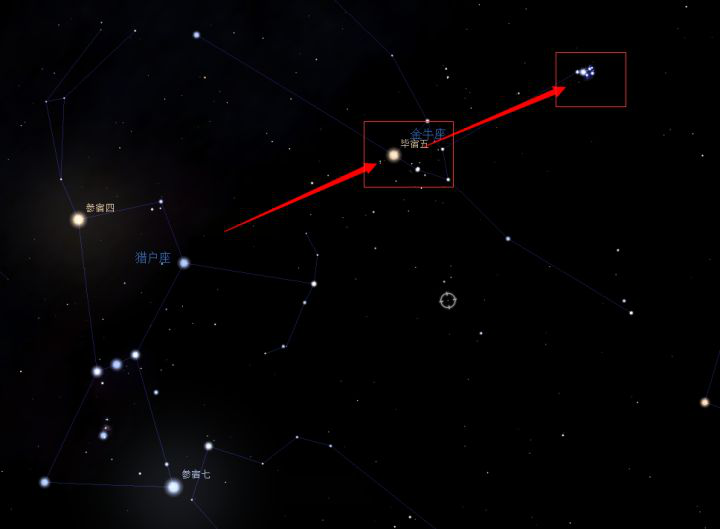
Move one Orion-width toward the upper right of the constellation to reach the bright star Aldebaran (Alpha Tauri). Continue by the same distance to find the famous Seven Sisters, the Pleiades. In ancient China, its bright stars formed the Mao lunar mansion and inspired many stories and myths. Most people can see six members with the unaided eye and more under good conditions, making the cluster a rough test of both eyesight and sky clarity. One member is relatively faint and therefore difficult to see. The cluster contains far more than seven stars—over three hundred—but most are very dim, so difficulty seeing them says little about your eyesight. Through binoculars or a wide-field telescope, the Pleiades are spectacular: more than one hundred stars appear across a field about 11/5 degrees in diameter. The cluster is too large to fit within the field of view of many telescopes even at their lowest magnification, and it contains numerous double and multiple stars. The Merope Nebula, NGC 1435, requires a dark sky and is best viewed at low power with a wide field; Tempel discovered it with a four-inch telescope.
Because the Pleiades lie only 4° from the ecliptic, lunar occultations of the cluster occur frequently. These events are appealing targets even for observers with inexpensive equipment. They are visible to the unaided eye, while even small binoculars or telescopes add detail. An occultation also demonstrates the Moon’s apparent size relative to the cluster. Burnham noted that the lunar disk fits inside the quadrilateral formed by the stars traditionally designated Mao 6, Mao 1, Mao 5, and Mao 2; under those circumstances, Mao 4 and even Mao 3 are hidden by the Moon. Planets also pass near the Pleiades, and Venus, Mars, and Mercury occasionally cross the cluster, producing striking conjunctions.
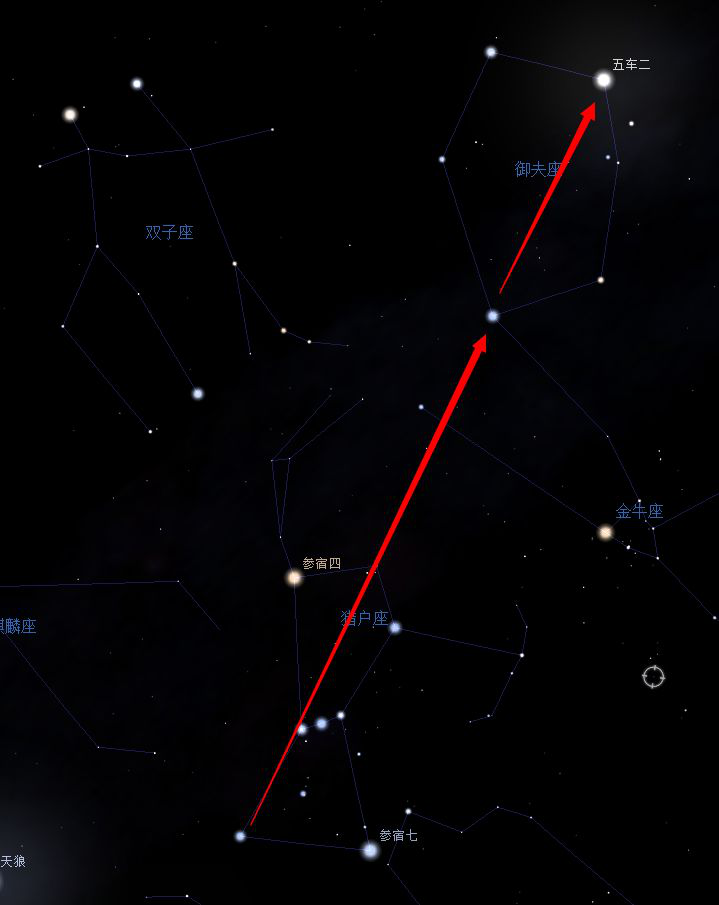
Extend the line from Saiph through Alnitak by twice the distance from Alnitak to Betelgeuse to find Iota Aurigae, a moderately bright star. Continue for another half of that distance to a bright star near the zenith: Capella. Both lie in Auriga. Capella is a binary system also designated Alpha Aurigae. Its name means “little she-goat.”
Capella is the sixth-brightest star in the night sky. It has an apparent magnitude of 0.08 and an absolute magnitude of 0.1. The system lies 42.2 light-years from Earth and consists of a G5 III giant with a G0 III companion. It is a spectroscopic binary with an orbital period of about 104 years.
The bright stars of Auriga form a pentagon. Epsilon Aurigae (Almaaz) is the constellation’s most intriguing star. It is an eclipsing binary with a 27-year period, the longest known for such a system.
Follow a line from Rigel toward Betelgeuse to find Gemini at the upper left. The bright star at the head of the left twin, near the upper-left corner of the image, is Pollux; Castor lies to its right. Gemini contains 47 stars brighter than magnitude 5.5. Its brightest, Pollux (Beta Geminorum), has an apparent magnitude of 1.14. The center of Gemini crosses the upper meridian at midnight on January 5. The entire constellation is visible between latitudes +90° and −60°. Pollux, Aldebaran in Taurus, Capella in Auriga, Procyon in Canis Minor, Sirius in Canis Major, and Rigel in Orion form the Winter Hexagon.
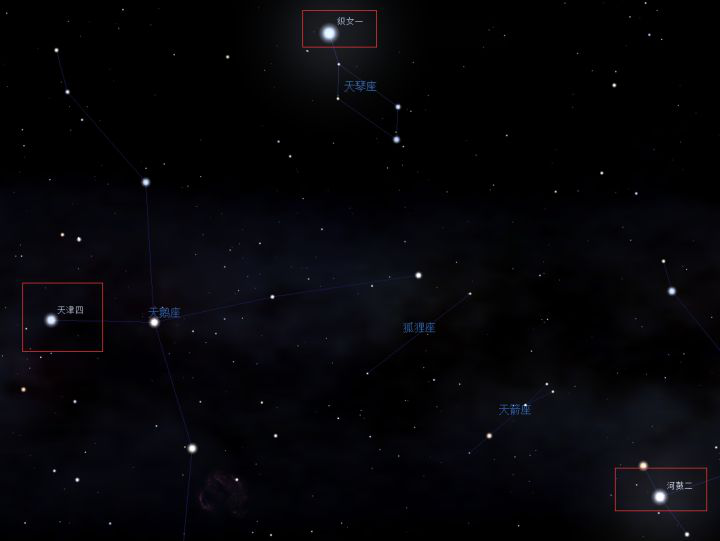
In summer, the famous Summer Triangle appears beside the Milky Way near the zenith. Its vertices are Vega in Lyra, Deneb in Cygnus, and Altair in Aquila. Vega and Altair are the Weaver Girl and Cowherd of Chinese legend. The two stars beside Altair, Alshain and Tarazed, represent the Cowherd’s two children. Start by learning the Summer Triangle, then use a star chart to identify the rest of the summer sky. Its connection to a familiar love story makes the pattern easy to remember and recognize.
Look up on a summer night and three prominent stars are easy to spot: Vega, Altair, and Deneb. Altair and Vega stand on opposite sides of the Milky Way. Vega appears alone, while two fainter stars flank Altair and represent the Cowherd’s son and daughter. The three stars on Altair’s side form a straight line, recalling the Cowherd carrying his children in baskets suspended from the front and back of a shoulder pole.
Contrary to some news reports, the Summer Triangle is not limited to a single special date. Once summer begins, it can be seen on any clear night. As autumn approaches, it rises earlier each day because Earth’s changing position in its orbit produces an annual cycle.
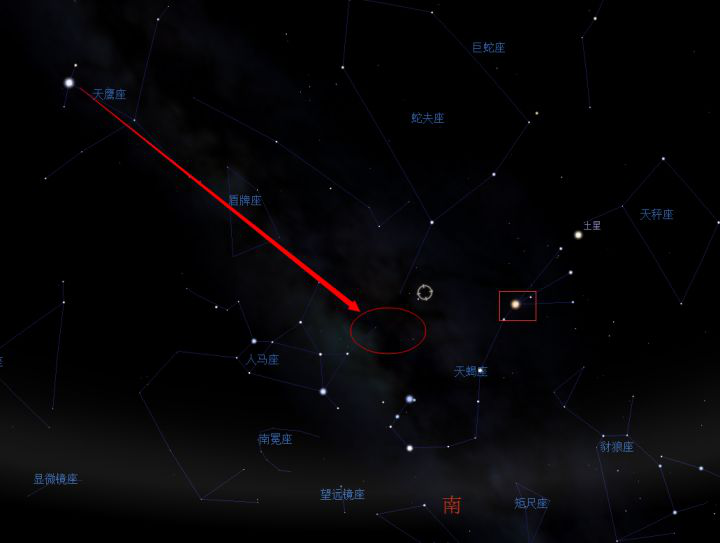
Around midnight in June, follow the body of Aquila toward a region close to the southern horizon. The yellowish star just right of center in the image is Antares, Alpha Scorpii and the principal star of Scorpius. It is the most isolated first-magnitude star in the sky, although several bright second-magnitude stars lie nearby. In ancient China, Antares was called the Great Fire and belonged to the Heart mansion of the Azure Dragon of the East. It represented the dragon’s heart and served as a seasonal marker. Antares is a well-known red supergiant that shines with a fiery color. At dusk each May, it reaches its highest point due south; by dusk in July, it has begun descending westward from the meridian, signaling that the heat will soon recede and autumn is approaching. The star was also called Dachen, Shangxing, and Tiansikong. Because the Heart Star occupied the mao position and Fire emerged from the heart of Wood, it was called the Great Fire. The Di, Fang, Xin, and Wei mansions correspond here to four stars of Scorpius. The “April” ode in the Book of Songs, Minor Odes, reads: “In the fourth month comes summer; in the sixth, the heat departs.” Mao Chang of the Western Han explained that cu meant “to go,” and that the sixth month referred to the Xia calendar, corresponding to today’s lunar calendar: when the Fire Star, Antares, culminated, the worst heat was passing. Zheng Xuan of the Eastern Han instead glossed the word as “to begin”: summer begins in the fourth month, but only in the sixth does the heat become intense. His moral analogy was that wrongdoing also develops gradually rather than overnight.
Ancient observers saw the seven mansions of the Azure Dragon rise in the eastern sky in spring and set in the west in autumn. Their cycle matched the agricultural year. When spring planting began, the Azure Dragon slowly rose in the east, with the bright Horn mansion appearing first. During the summer growing season, it hung high in the southern sky. As the crops were harvested in autumn, it descended in the west. In winter, when living things lay dormant, it remained below the northern horizon.
Mars Guarding the Heart
Mars and Antares are the two reddest objects in the sky. Mars was called Yinghuo, the “flickering fire,” while red Antares was the “Great Fire.” When these two fires met, they seemed to compete in color. Yinghuo was regarded as an ill omen. When Mars lingered near the Heart mansion during its apparent retrograde motion, people in ancient monarchies interpreted the event as a sign that either the chief minister would be dismissed or the ruler would die. The phenomenon therefore received close attention and became known as “Mars Guarding the Heart.”
Mars comes close to Earth once every two years and two months. Because its orbit is more elongated than Earth’s, a particularly close approach occurs only every 15 to 17 years.
At conjunction with Antares, Mars may pass within 1.8°, less than the width of four full Moons placed side by side. The meeting of the sky’s two reddest objects is especially conspicuous.
Three Stars in a Line
The unusual alignment of Saturn, Mars, and Antares occurs only once every 30 years. In clear weather, it can be seen throughout China and on all seven continents, with better viewing conditions in the Southern Hemisphere than in the Northern Hemisphere. Observing can begin 40 minutes after sunset and continue for more than 120 minutes. Look slightly west of due south.
“The Fire Flows West in the Seventh Month”
The abridged Cihai, page 952, explains the phrase “the fire flows” as follows: “Fire is the name of a star, the Heart mansion. At dusk in the fifth month of the traditional calendar, the Heart is on the meridian; after the sixth month, it gradually shifts west, as the summer heat begins to ease.” Kong Yingda similarly wrote: “That which moves west in the seventh month is the Fire Star; this shows that colder weather is approaching.” The phrase “the fire flows west in the seventh month” concerns the season and climate, but it does not describe extreme heat. Yu Guanying’s Selected Translations from the Book of Songs puts it more directly: “When the Great Fire Star moves down toward the west after dusk in autumn, this is called ‘the fire flows.’” The “seventh month” is the seventh month of the traditional calendar; “flows” means moves or descends.
The Great Fire Star is a well-known red giant with a fiery glow. At dusk in the fifth month of the traditional calendar, it stands highest due south. By dusk in the seventh month, it descends westward from the meridian, showing that the heat is subsiding and autumn is near. This is the phenomenon called “the fire flows west in the seventh month.” The Airs of Bin in the Book of Songs begins: “In the seventh month the Fire flows west; in the ninth, winter clothes are issued.” The first line signals that the weather is cooling; the second says that it is time to make winter clothing. Three thousand years ago, people used a lunar calendar, so the seventh month then corresponds roughly to August today. To observe the same seasonal sky now, look in September by the Gregorian calendar.
Conclusion
Star-chart software is now remarkably capable, but learning to identify regions of the sky remains essential for amateur astronomers. Recognizing those regions and understanding their important phenomena makes observing faster and more efficient.
 爱发电(点击图片跳转)