How to Change the World and Make Your Life Count
Author: Zi Bo (ZiBo)
Reviewer: Weiming
Hi, I’m Zi Bo (ZiBo), and I just graduated this year. I’m not quite sure why, but here I am writing an article for you. The last time I remember a Chinese teacher praising my work was in sixth grade. His comment: “If you didn’t copy this, it’s very well written!” So even if I fail to entertain you, I promise not to waste your time.
I’m an introvert, and I spend a lot of time looking up at the sky. Classmates who run into me sometimes ask, “Pondering life again?” I just smile. (They do say hello, because I’ve never been the sort of person who fades into the background. I’m introverted, but I don’t enjoy being invisible.) I like to think. I understand the appeal of both “If I learned the Way in the morning, I could die content that evening” and “Learning makes me happy.” That does not make me extraordinarily well read or a star student. I dislike shallowness and admire depth of character. I’m not a badass; I just enjoy pretending to be one.
All right. Knocks on desk. Time to get to the point!
“To live is to change the world.” It is the one line from Steve Jobs that stuck with me, and it matters. At a low point in my life, when I felt lost, those words gave me a reason to live and an answer to what life meant. As someone who fancies himself a thinker, I had happened to spend some time on that very question: “How can we change the world and make our lives count?”
Let me say it once more: “How can we change the world and make our lives count?” Clear your head, then place yourself in this scenario:
Imagine a world with five people: you, Black, Red, Blue, and White. You want to change that world. Black is a doctor; Red, Blue, and White are ordinary people on the street. Those five people and their surroundings are the entire world in question. Here is what you know: Red is starving, Blue is sick, Black is an excellent doctor, and you have no idea what to do with your future.
One problem remains unsolved: Red is starving, and nobody can cook. That is your understanding of the world; you have identified something the world needs. But you should not immediately vow to become a cook, because you have yet to take stock of yourself. What if you had no hands? The first step is therefore self-knowledge: find out what you have to work with.
Once you know yourself, you discover that your family has produced cooks for generations—and that the book propping up a table at home is a long-lost cookbook. Let us call your understanding of yourself and the world your worldview. Put the two together, and at last it becomes clear: you really should be a cook. Now you have a goal. We will define the essence of a goal as creating a particular need. The next step is to pursue that goal with what you already know; we will call the means of doing so a methodology. The goal, stated plainly, is to become a cook and make a fragrant, delicious meal for hungry Red. Cooked rice comes from steaming rice, while rice and vegetables are grown in fields. Let us call these things resources. Achieving a goal, then, means gathering resources and combining them effectively until they meet the “particular need.” You might grow the rice yourself or buy it, giving us “internal resources” and “external resources.” In real life, many resources are external. Someone born into wealth, for instance, may already enjoy the circumstances you hope to spend a lifetime achieving. For ordinary people like us, the ultimate question is how to acquire internal resources steadily and efficiently: how to prepare the rice and vegetables quickly and well, learn the best culinary skills, develop the best recipes, and master sautéing, deep-frying, and other techniques. In broad terms, this is learning. Learning hurts, and learning is joyful. Just as important is the constant improvement of our methodology. Our methods grow out of our goals and existing understanding, but that understanding may be incomplete. As the saying goes, “Practice determines knowledge.” We should regularly reflect on our own experience and read the books in which other people have recorded theirs. These are “internal resources.” At the same time, we cannot afford to dismiss “external resources.” Cooperation may be difficult, but it is enormously powerful.
Here is a mind map. Today is November 13, and, as it happens, I drew this exactly six months ago on May 13:
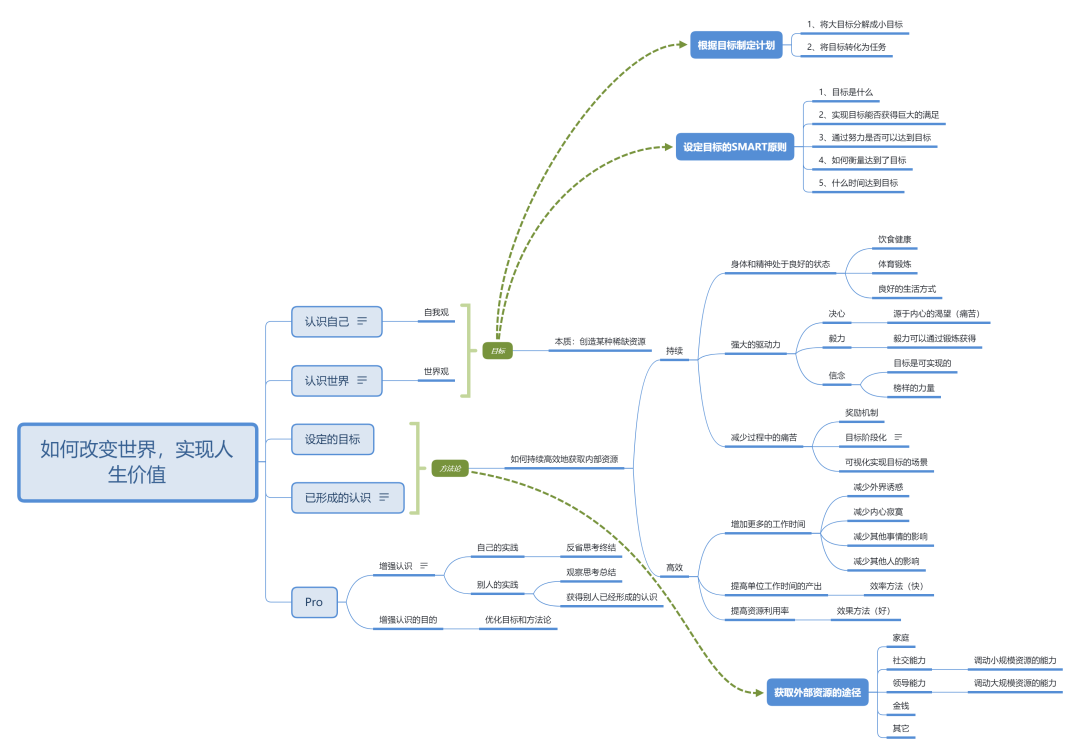
Writing is not exactly my strong suit, and this is an enormous question. So far, all I have is a rough framework. I hope to keep refining it.
This is the most important idea at the center of my thinking right now, and I wanted to share it. I have not fixed the typos in the mind map; please be aware of them, and accept my sincere apologies if they get in the way.
My thanks to the APC Science Outreach Group. Without it, I doubt I would ever have turned these old thoughts into an article.
 爱发电(点击图片跳转)