A Brief History of Humankind: The Cognitive Revolution
Author: 自控力
Reviewer: Nancy
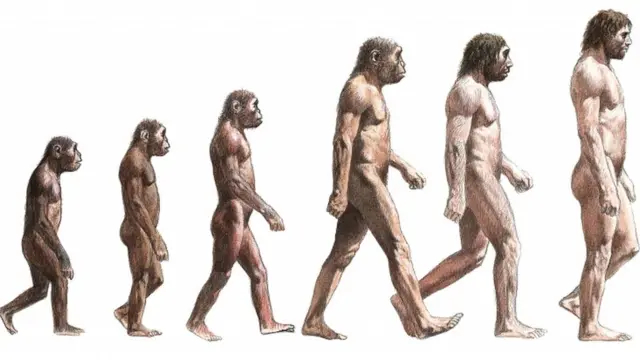
The familiar “march of human evolution” is misleading. Human evolution was not the straight, single-track road shown in that image, but a flourishing tree with many branches. More than fifteen known species once belonged to the genus Homo. Neanderthals, Homo erectus, Homo floresiensis, and others shared the Earth with our ancestors, Homo sapiens, for long stretches of time.
Where did this deeply misleading linear image come from? It first appeared in the popular-science book Early Man, published in 1965. The book originally included an elegant, elongated foldout depicting hominins at different stages. Because the illustration was so long, later layouts compressed and folded it to save space. The figures consequently appeared to be walking forward in a line, eventually giving us the linear version familiar today.
In the struggle for survival on ancient Earth, Homo sapiens was not as strong as the Neanderthals, nor were we the most agile. Why, over the long course of time, did all our other “brothers and sisters” become extinct, while only we
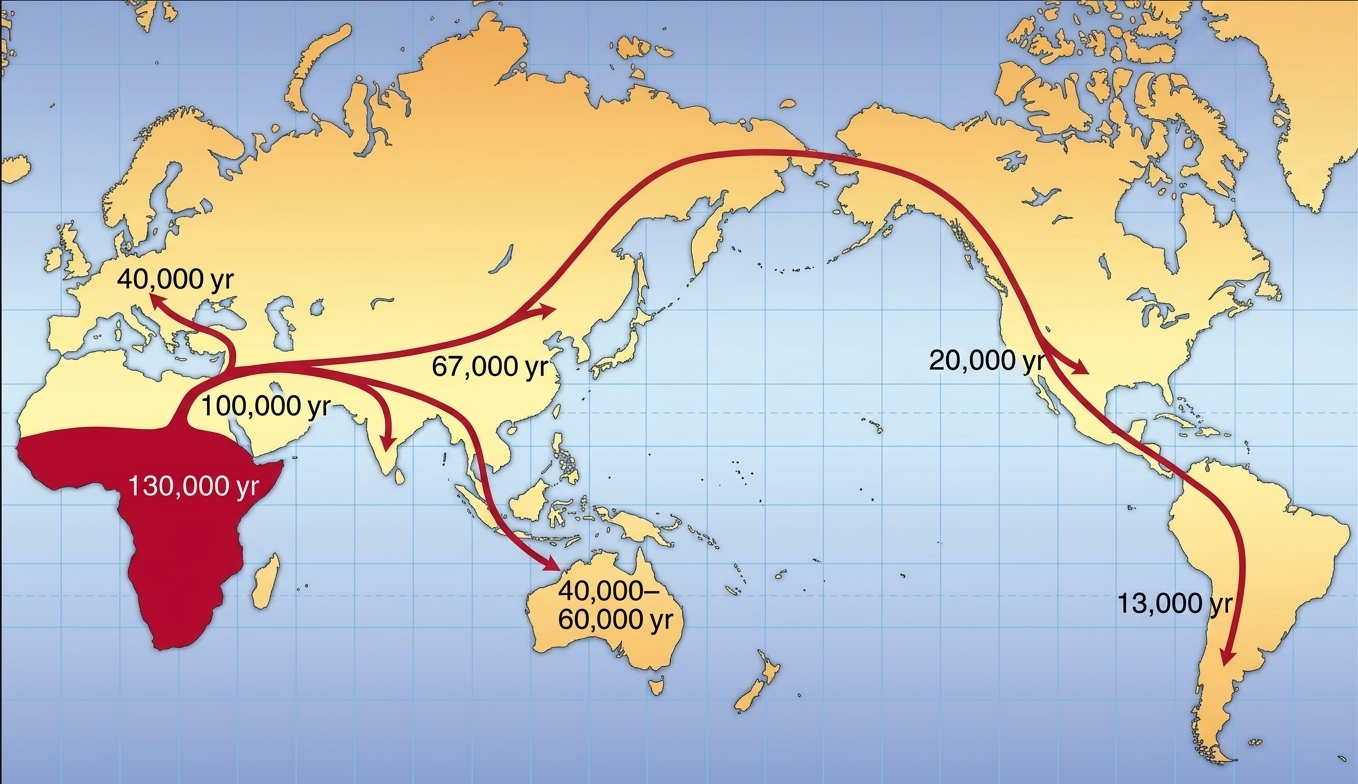
Researchers studying human origins generally agree that modern Homo sapiens arose in sub-Saharan Africa, centered on the East African Rift, where our ancestors gradually emerged several million years ago. Some fossils, however, suggest that members of the genus Homo may also have lived elsewhere in the world during the same period. This evidence has given rise to two principal frameworks: the Out-of-Africa hypothesis and the multiregional hypothesis.
Early human groups did not differ greatly from one another. Many left Africa and evolved separately in different regions, gradually becoming distinct archaic human populations. The process resembled the branching of the cat family into lions, tigers, leopards, and other very different animals. Among the human species that evolved early were the robust Neanderthals and the diminutive Homo floresiensis. All had learned to think, but the expansion of the brain came at a heavy cost for early humans.
A mammal weighing about 60 kilograms generally has a brain volume of roughly 200 cubic centimeters, whereas early humans such as Homo habilis already had brains of about 600 cubic centimeters. It was as though they had installed an extra, high-performance CPU. Humans then relied on their exceptional intelligence and struggled onward for tens of thousands of years, until at last… nothing happened. At first, a more capable brain brought no obvious benefits. Instead, it made human life even harder.
In other apes, the brain generally accounts for only 8 percent of total energy consumption. In humans of the same period, it consumed a full 25 percent. Ancient humans had only so much food each day, so where could they find the energy to pay this much larger bill? They cut their investment in physical strength and put all their skill points into intelligence. It was rather like a country at war diverting a large share of its budget to education.
The enlarged brain was not entirely useless, however. Early on, it provided two crucial abilities that kept ancient humans alive until its real advantages could emerge: relatively efficient social organization and the use of tools. In the wartime-country analogy, education produced capable military personnel and scientists who could design weapons.
Homo sapiens was not the only species to develop social organization and tools. On the contrary, many human species that preceded us had already acquired both. Why, then, did only Homo sapiens reach the brain’s tipping point? Many social animals, including wolves and lions, live in organized groups. Ants, bees, and similar animals have even evolved what is known as “eusociality.” Primates such as chimpanzees also crack nuts with stones and extract termites with twigs. The brain merely amplified these two human abilities.
For two million years of human evolution, however, all this did little more than keep our populations from dying out. Around 800,000 years ago, humans learned to use fire, and cooked food drove brain evolution further. By roughly 400,000 years ago, some archaic humans could hunt large animals with reasonable consistency.
Before our own ancestors appeared, other human species had already mastered the skills needed for survival and occupied habitable regions across the Earth. It was like standing idle at the spawn point while everyone else had already bought their gear and taken over every part of the jungle. Only about 300,000 years ago did our ancestors, Homo sapiens, emerge in Africa, the cradle of humankind. In appearance, these early sapiens already looked much like people today.
Early Homo sapiens quickly acquired the survival skills possessed by other human species, but that was not enough to compete with them. In Harari’s account, a revolution 70,000 years ago set every later change in motion. It enabled Homo sapiens to sweep across the globe, drive other human species to extinction, and reach places none of them had ever entered. That transformative event was the Cognitive Revolution.
According to Harari’s hypothesis, the early Cognitive Revolution began when Homo sapiens learned to “tell tall tales.” That single ability propelled our species to the top of the food chain and consigned many other organisms, including other human species, to the evolutionary dustbin.
The Cognitive Revolution is generally thought to have emerged first through language. One explanation is the lion theory: in the same situation, human language can convey far more information. A vervet monkey may scream to warn its companions of a lion, sending them fleeing into the trees, but the warning is indiscriminate. The others do not know where the lion is or how many lions there are. The language used by early Homo sapiens as they left Africa and spread across the world was more complex and information-rich. Someone who spotted a lion could tell the others where it was, what it was doing, and how many there were, allowing the group to decide whether to stalk and kill it or run away.
Another explanation is the gossip theory. Once humans acquired language, they could assess other members of their group and quietly discuss their strengths and faults. That may seem pointless today, or even harmful to a tribe’s survival, but gossip has its uses. It tells us who is reliable, who is clever, and who excels at hunting or making stone spears. Because it is difficult to get to know everyone personally, this information makes the whole group more effective. Gossip lets us learn about other members more easily and cooperate with them. In a school relay, for example, hearing that one of our runners is the fastest sprinter in the school would reassure us. We may never have seen that person run, but gossip can still provide useful information.
Whether the lion theory, the gossip theory, or some combination of the two is correct, the feature of language that ultimately carried the Cognitive Revolution forward was our ability to “tell tall tales.” This means confidently describing something that does not exist or could not happen. Humans thereby became animals capable of inventing things absent from reality. We might solemnly tell the rest of the tribe that a mountain is alive and embodies a spirit, and that unless we worship it, we will catch no prey, find no edible fruit, and locate no suitable stone for tools.
This ability to tell tall tales is, of course, imagination expressed through language. We do not know whether our Homo sapiens ancestors first evolved language and then imagination, or first developed imagination and then learned to put it into words. We do know that once Homo sapiens could imagine, shared fictions such as a sacred mountain allowed cooperation on a much larger scale. Gossip alone can sustain groups of no more than 150 people, while wild chimpanzee communities generally contain only about 20 to 50 individuals.

If neighboring groups shared a belief in the same sacred mountain, however, they could work together to preserve a hunting ground and drive away other tribes that entered it. With this stronger capacity for cooperation and imagination, Homo sapiens swept across the world like a flood 70,000 years ago and became its most powerful organism. So what happened to our other brothers and sisters? Genetic research now shows that it was not simply a massacre. Although most other human species became extinct, migrating Homo sapiens also had intimate encounters with Neanderthals and Denisovans. Most people alive today still carry a small amount of the blood of those brothers and sisters who disappeared tens of thousands of years ago. Homo sapiens did not replace them completely. We carried their traces with us as our species alone sped down evolution’s fast track.
 爱发电(点击图片跳转)